Thursday, May 04, 2023

Still Going On


                                            C'mon talk to me
                                            So you can see
                                            What's going on

                                            (Marvin Gaye - 1971)

Recently I found myself thinking back to the spring/summer of 1970. I was young then, still a student - twenty years old.  

It’s May 4th.  And I have a vague recollection of preparing to leave my parents’ house for a night shift in Hamilton at Stelco’s #2 Rod Mill.  Around 10 p.m. I heard the news. There had been people killed in a shooting earlier that day at Kent State University (KSU).  

What were my thoughts at the time?  Mainly about myself I’m afraid.  Two years earlier I had embraced a rather unrealistic dream of attending Kent State on a track scholarship.  If I had been granted one, I would have been finishing my second year at a small liberal arts school in conservative northeastern Ohio. It was only 275 miles away from home. What would I have been doing when the shots rang out?  Would I have been protesting? Studying? Out for a run? Sleeping in?

Unknown individuals had burned down the campus ROTC building on May 2nd. On this Monday students and other demonstrators had been in their third day of protesting the invasion of Cambodia and escalation of the Vietnam War.  President Nixon had described the military action as an “incursion.” A euphemism, I’d say.

You’ll remember that four students were killed. Perhaps you’ll recall more details - like nine wounded (one permanently paralysed) when twenty-eight National Guardsman fired off about 67 rounds in just 13 seconds.
 
CSU Archives/Everett Collection

A 20-year-old from Youngstown Ohio, speech therapy student Sandra Lee Scheuer,  was one of the four who died that day. Ten years later Canadian Gary Geddes in his poem Sandra Lee Scheuer wrote:
  
                       
                        She did not throw stones, major in philosophy
                        or set fire to buildings, though acquaintances say
                        she hated war, had heard of Cambodia.


Shortly after the tragedy Neil Young, having come upon a picture of a KSU student “dead on the ground,” documented the event with the song Four Dead in Ohio.  Crosby Stills Nash and Young recorded it.   Almost overnight Four Dead was a hit and became one of the best-known protest songs in history.   It pointed fingers, named names.  

                            “Tin Soldiers and Nixon’s Coming.
                            We’re finally on our own.
                            This summer I hear the drumming.
                            Four Dead in Ohio."


Protests expanded across America; schools closed.  People took to the streets.

The violence spread down south to where Jackson State brothers.  Learned not to say nasty things about southern policemen's mothers. (The Beach Boys - Student Demonstration Time, 1971.)  

Many miles south of my home late on May 14th, more students were shot.  This was at Mississippi’s Jackson State College, a school attended primarily by black students. State and local police fired hundreds of rounds into a women’s dormitory from just 30-50 feet away. Every window was blown out on the street side of the building.  Two young black men were killed. At a minimum twelve were injured as it is likely others were fearful of reporting their injuries.  

Across from the besieged girls’ residence on Lynch Street, a 17-year-old high school senior, a runner who dreamed of attending UCLA, heading home from a part time job, was gunned down.  Later that night family members searched for him.  Incredibly, no one in authority reached out to the family to say Earl Green was dead.  Unbelievably, no one was ever held responsible for his death or that of 21-year-old father and Jackson State honours student Phillip Lafayette Gibbs.

The Jackson College shootings never received the big headlines and media attention that Kent State did.  The uprising that triggered the excessive police response was less about the war and more about that other American bifurcation – racial injustice.

Back Home
 
Later in that summer of 1970 I was part of the Torch Team that carried the ceremonial flame to Flint Michigan for the CANUSA games. The games were, and still are, an annual gathering between Flint and Hamilton Ontario promoting goodwill through amateur athletics.  Twelve of us covered the 250-mile distance through Port Huron arriving in Flint on a Friday evening to officially open the games.

Over that weekend I was privileged to meet other young athletes; Americans my age, with interests similar to mine.   But their obsession, among the men at least, was the recently introduced military draft and whether their birthdate would be drawn and not the many trivial pursuits that engaged me. 

I returned to school in September where among other subjects I studied U.S. and Canada comparative politics. Peace order, good government - that’s us.  Life, liberty and the pursuit of happiness is what America is built on.  That was the basics back then that I grasped to the extent a young student could.  Today, I wonder if the relative consensus in our political life in Canada contrasted to the extreme polarization down south can be traced to these different guiding principles.

Looking back, I can hear sirens wailing, the shattering of glass, the acrid smell of a burnt armoury, pinging of M1 military rifles. I can sense the fear of an unknown future and try to imagine the frustration felt by those dealing with racism and discrimination.  Plus ca change.

Where I live now is only 17 miles to America.  Somehow it seems farther away.

Friday, March 31, 2023

Encampment Precedent

Here is a longer version of an article I wrote that was published in the Hamilton Spectator on March 25th.  You may find it at https://www.thespec.com/opinion/contributors/2023/03/25/kw-encampment-precedent-could-apply-in-hamilton.html

------------------------------------------
Last year in Hamilton a judge ruled that an encampment could be cleared from a city park as there were enough shelter spaces in the system to accommodate those living in the encampment.

It was a different judicial result in Kitchener when a ruling came down in January.
Justice M.J. Valente of the Ontario Superior Court of Justice ruled that the Region of Waterloo can’t evict people living in tents from a vacant lot the Region owns. It is believed that the ruling is precedent setting.  

The issue revolved around a vacant lot at 100 Victoria Street in Kitchener’s downtown.

The Region wants to use the space for a lay-down area for the construction of a transit  hub. 
Back in December 2021, Waterloo had evicted tenants from an encampment on Stirling Street East using steps they believed “were consistent with the requirements of a by-law.”

They did concede that “the manner in which these actions were carried out did not reflect the dignity of those living at the encampment.”  No kidding!  Staff enlisted the help of a road maintenance crew with heavy equipment to clear the Stirling Encampment. 

As a result, the Region felt the need to clarify how it might enforce its legal rights and so brought an application to seek the direction of the Court.

It was the Region’s opinion that the conditions at the encampment posed a risk to the health and safety of encampment residents as well as to that of others. As a result, the Region determined that the encampment had to be disbanded. 
What is it like in that encampment?  

Every individual will have their own story but one that Justice Valente heard from 32-year-old Kathryn Bulgin, homeless for approximately 6 years, is instructive.   Ms. Bulgin is a victim of both physical and sexual assault and currently suffers from drug addiction.   Before living at the Victoria street encampment, she slept in hotel rooms, shelters, behind dumpsters and couch surfed. 

For her and many others shelter bed accommodation can be “very stressful” because there (is) no certainty if a bed (will) be available.  Ms. Bulgin (does) not have a watch or phone.”  The result is that she can’t always return at a designated time to claim a bed. If evicted from the encampment Ms. Bulgin would simply move to another campsite.

This is an important issue that Justice Valente explores in considerable detail. Shelters don’t work for many people.

Dr. Andrea Sereda is a physician practicing at the London Intercommunity Health Centre in London, Ontario. In testimony, she cited five reasons why encampments have advantages over shelter use.  Encampments decrease isolation and risk of fatality and decrease forced transiency that increases the odds that the unhoused can maintain a connection to outreach services. They give people a sense of community. minimize sleep deprivation and provide physical and mental rest.

Interestingly staff challenged Dr. Sereda’s value as an expert because she had not talked to any residents of the encampment.  Staff’s contact with residents was far from comprehensive.  

As local governments are inclined to do, the Region developed policies and procedures that would apply to the estimated 1,100 individuals considered homeless in Waterloo..  Justice Valente had some praise for their work; he had some criticisms as well. For example, it seems staff presented data in a way that would justify their opinion.  Small actual increases in incidents calculated as part of a risk assessment at the encampment site looked a lot more concerning when presented as percentage increases.  

Advocates have long argued that housing is a basic human right.  In fact, the government of Canada supports the progressive realization of the right to adequate housing as part of their National Housing Strategy.

Section 7 of the Charter states that  “everyone has the right to life, liberty and security of the person and the right not to be deprived thereof except in accordance with the principles of fundamental justice.”

Justice Valente took a look at the fairly extensive litigation that has occurred regarding the right to shelter as it relates to Section 7 of the Charter.  His conclusion can be summarized in a few words.  

The individuals encamped at 100 Victoria St. have a right to be there under Section 7. 

“Because the By-Law prohibits the erection of shelter protection that is necessary to protect homeless individuals from risk of serious harm, and there is currently inadequate shelter beds in the Region, I conclude that it violates the Charter protected right to life,” writes Valente.

Shelter Beds

Municipalities have made this argument for years.  It goes like this: “There are vacancies in the shelter system.  So people are able to stay in shelters.”  

But the actual number of shelter beds available or not available is contentious. 
Justice Valente picks this up recognizing “that it is not just the number of available indoor sheltering spaces that frames the right but also whether those spaces are truly accessible to those sheltering in parks.”

The Region made two other arguments that were rejected.

First, they contended that the Charter doesn’t apply because the encampment residents were looking to protect property rights, which are not Charter protected.  Not so, said Justice Valente.  They weren’t making such a claim.  Encampment residents just preferred to be close to services they regularly use.

Another Regional argument was that previous Ontario court decisions supported evictions.  But those decisions dealt with parks, where the broader public had an interest in using, not a vacant lot such as the site in question.

If evicted from the encampment where will residents go, Valente wondered. Likely to live rough or set up camp somewhere else.  What choice do they have?  Creating shelter to protect oneself is, a “matter critical to any individual’s dignity and independence.” By preventing this, the Region interferes with the “choice to protect itself from the elements and is a deprivation of liberty within the scope of section 7.”

Waterloo Region has decided not to appeal the ruling. 

Sharon Crowe, a lawyer involved in the Hamilton case,, is optimistic that the decision will be a catalyst for change.
  
“Not only are they not appealing, they are investing $163 million into housing and homelessness.”

The City of Hamilton is now back at the table talking with advocates. Hopefully, others will follow suit. 

Wednesday, March 15, 2023

Empty Buses


(Here is a little story on public transit I made up based on my experience as a municipal councillor  many years ago.)  
----------
One thing I’ve learned in my short career in municipal politics is that municipal politicians know how to problem solve.  It is what they do.

And the elected officials at Clarovista City Hall are no exception.

Take the issue of public transit for example. 

Public opinion is divided on transit in Clarovista.

Some people want it.  And others don’t.

Now the people who want it are mostly those that use it or would use it if the service was any good. 

Those that don’t want it or don’t want much of it or don’t want it on their street mostly have garages and two or three cars in their driveways.

These people with cars and garages worry about buses a lot particularly the matter of empty buses.  And they let their Council members know how they feel.

Councillor Roger Harris is particularly responsive.  Few buses run through Councillor Harris’ ward.  

Those that do certainly look empty to his constituents.

I’ve tried in public and in private conversations to explain empty buses to Harris. They happen routinely in the transit world, I say. They get empty when going in the opposite direction to rush hour peak flows and at the end of routes. Some times of day are less busy and some areas of the municipality have fewer riders. 

Harris himself has not been on a bus since riding a yellow one to day camp back when Diefenbaker was Opposition leader and C.D Howe and the Liberal Party were arrogant and flogging pipelines.

Harris has ideas for transit management to address the empty bus dilemma. Small buses are the way to go. They cost less and the optics would be better.  And, if the route ran every hour instead of every 20 minutes, we could save money.  Councillor Harris puts energy into the sketching out better routes for the buses.  Tricky stuff.  

Tonight, we receive the annual transit review.  It is the only area we review each year.  Questions of staff focus on efficiency, pros and cons of raising fares, decreasing support from the province.  

Councillors have ideas in all of these areas.

But Councillor Harris’ brainwave stops the meeting.

“Why can’t the buses just go back to the garage when they are empty?”

by
Ken Williams
Former Councillor
Ward 5
Clarovista


Thursday, March 09, 2023

Truth Has Vanished


Like the passenger pigeon it seems that truth has vanished forever from our political discourse.
 
Not that long ago when Trump was President of the United States and still tweeting he posted a tweet where, in one sentence, he made 4 false claims.  (A tweet is about  two short sentences.)
 
This came as no surprise to those paying attention to the state of today’s politics.
The People's Premier?

In Ontario the Premier, of his self-styled Government for The People makes promises like:
                              
                No one will lose their job, absolutely no one.
                      
                I’ll lower hydro rates by 12 per cent.
                             
                We won’t touch the Greenbelt. of Ontario 
 
It is not enough that the promises are unfulfilled but that such statements are repeated so often that they become assumed authentic.

So what about truth?
Eric Blair, Spanish Civil War Veteran
George Orwell  had something to say on the matter. The English writer argued that history had, in fact, stopped in Spain in 1936. Orwell had seen that reporting in Spain’s newspapers “did not bear any relation to the facts, not even the relationship which is implied in an ordinary lie.”
 
Orwell, then a virtually unheard of English writer known as Eric Blair, worried that the “concept of objective truth (was) fading out of the world and lies would pass into history.”

 Seniors for Climate Action Now (SCAN!)


For the past couple of years I’ve been involved with a group called Seniors for Climate Action Now (SCAN!) https://seniorsforclimateactionnow.org/
 
SCAN volunteers spent a good deal of time and energy prior to the June 2nd provincial election documenting Ford’s crimes against Climate.  New crimes against the environment like the More Homes Built Faster Act are being documented but it is hard to keep up with this repeat offender.   These crimes all seem stem from the kind of thinking that denies objective truth.  A case in point is the rationale recently put forward to open up lands in the Greenbelt  in order to build so-called affordable housing. 
 
Much has been written and said by experts, advocates and citizens regarding Bill 23 the More Homes Built Faster Act (2022).  Here is SCAN!’s view https://seniorsforclimateactionnow.org/wp-content/uploads/2023/02/SCAN-Climate-Crime-34-2023-01.pdf
 
The Ford government is well aware of the opposition to their measures but has calculated that the public will just accept them because they are passed.  

We can`t give up the fight.  Here are some resources and links you can check out.
          
Resources and Events
 
*You can find Environmental Defence at https://environmentaldefence.ca/
 
*Changes to maps and Official Plans can be found at https://ero.ontario.ca/notice/019-6216#decision-details and https://ero.ontario.ca/notice/019-6217
 
*Alliance for a Livable Ontario is at https://www.liveableontario.ca/
 
*The Land Between, a grassroots non-governmental organization, has materials on the  consequences of the legislation and what you can do at https://www.thelandbetween.ca/bill23-stealingourlegacy/#Solidarity

*The webinar Bill 23 and the Greenbelt – What`s Next? runs about an hour and can be found at https://www.youtube.com/watch?v=C_j49m11Q7w

*Stop Sprawl Halton’s website is at https://www.stopsprawlhalton.org/

Tuesday, February 07, 2023

Lessons Learned from Delegating


Sometime when you’ve got nothing better to do head down to your local Silly Hall or Regional Government (if you are lucky enough to have two municipal governments) and delegate.

 It is your civic duty. In that spirit I combed my hair, put on the closest thing that I’ve got to church clothes, and headed off to the Region of Halton Canada some time back to address the budget. 

Delegating is always a learning experience. 

Here is what I learned. 

First, when you are finished speaking don’t sit down. Once you sit down Councillors will ask staff questions and you will have no ability to respond. Staff can say anything like: Bob Wood has a point but he would have more credibility on poverty issues if he hadn’t got his Grade Eight diploma out of a vending machine. 

Second, Councillors will not ask questions that you are expecting. I came prepared to answer in the negative as to whether I or members of my immediate family and/or committee colleagues had ever been members of the Communist Party. You can imagine my surprise when asked whether I thought water rates are regressive. 

Third, expect to engage in philosophical first year university discussions when you believe the agenda is fairly focussed or alternatively expect to focus on the agenda when you would like to engage in airy fairy dialogue. 

And finally, remember when you get the urge and feel like delegating that these issues are always too complicated for the public. That is why God created politicians, I guess.

Monday, January 23, 2023

Canada Jays, Moose and Citidiots

Typically in November we take a trip to Canada’s oldest provincial park, Algonquin. 

We’ve been doing this for quite a few years.  There is no great plan behind these trips. 

They started out when my son had responsibilities for volunteers who came to Norfolk County to assist with migration monitoring at Long Point.

A large number of species can be observed passing through Long Point in the fall but some of the more notable Canadian birds never make it this far south.  This unofficial November trip at the end of the migration season gave these volunteer birders an opportunity to see these birds before they returned home to the U.K., B.C., and Mexico or further afield.  

Looking back on these recreational outings, I wonder if there are some climate change lessons to be learned.

The main interest on these trips is to locate and observe boreal bird species - pine grosbeaks, boreal chickadees and crossbills.  Another boreal bird – the Canada Jay - although not hard to find - is of interest to casual as well as avid birders.  Algonquin is the extreme southern limit of its range.  The last time one of these passerines was seen here in Norfolk County was October 1975.

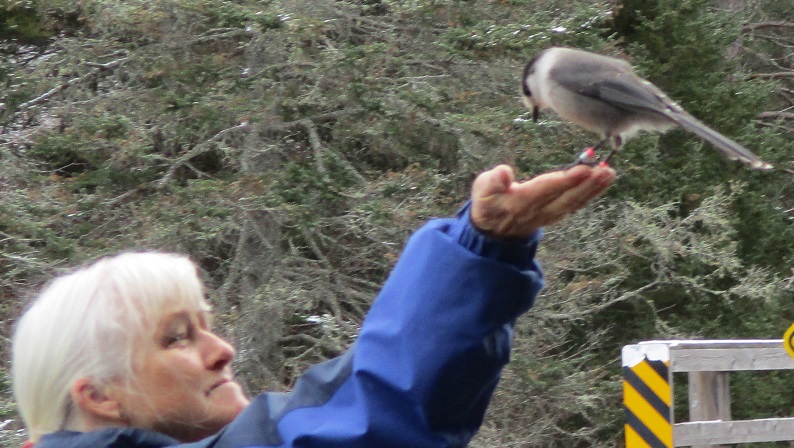
These birds are unique. They will feed from your hand and a common sight is to see them land on the heads of park visitors at the Spruce Bog Boardwalk. They’re the only birds in the boreal forests that stay on territory for the entire year. Through an astounding ability to store food, the Canada Jay survives long cold winters by living off thousands of pieces of food hidden in boreal vegetation.  Remarkably, research shows that the Canada Jay actually remembers where they’ve hidden food.

For nearly fifty years, most Algonquin Park Canada Jays have been colour banded thereby providing an excellent database on the species. There was a time when they inhabited all the land along Highway 60.  Not now though.

The cause of that decline is almost certainly climate warming.  Warmer temperatures in the park mean that the stored food isn’t lasting as it did in the past.

According to researcher Dan Strickland:

“As global temperatures rise, we can expect that insects, berries, pieces of meat or mushrooms stored by Canada Jays will spoil more rapidly. This will occur even in the winter and may be especially serious when repeated freeze-thaw events accelerate the degradation of perishable food. The cumulative effect of such warming may be that early-nesting (Canada) Jays have less stored food to feed their nestlings than in the past and fewer young jays are produced as a result.” 

Is it possible that a species that resides in all of the provinces and territories and is under consideration as our National Bird will become locally extinct? 

Moose

Back on Highway 60, I’m recalling an encounter with moose from ten years ago - a cow and its calf. (below left)  Although 800,000 people visit each year there isn’t much human traffic in the Park this time of year but on this day this pair attracted a bit of a crowd. Many passersby left their cars to get close to nature thus imperilling themselves and their vehicles.  Experts tell you never approach a moose and stay in your car if observing because they’re big (cows about 400 kg), protective of their young, and can run about as fast as a horse.  

Photo by Graham Wood
Older son Ross got it right that day when he called these wildlife observers “citidiots.” They seemed under the impression that the moose had been placed by the swamp for entertainment as part of some kind of roadside petting zoo. 

One has to wonder whether the ignorance on display that day has some connection to today’s climate warming deniers.  Not as overt stupidity as that practiced by those citidiots disturbing the moose but further evidence that some of us city folk just don’t get it.

Moose populations are in decline in some areas.  The science is tricky.  The latest published Moose Aerial Inventory for Algonquin from 2015 suggests there is a population of 2,655 individuals within the 7,725 square kilometre park.  Not as high as it was, but not bad and, in fact, in density terms among the highest in North America.  But there is danger from winter ticks.  That warmer weather we mentioned is increasing the survival rate of tick eggs.  These ticks actually travel on moose bringing on anemia, fur and weight loss and infection particularly in calves.

The UN Secretary-General recently sounded a warning: 

“Floods, droughts, heatwaves, extreme storms and wildfires are going from bad to worse” and are “breaking records with alarming frequency. They are the price of humanity’s fossil fuel addiction,” declared António Guterres.

These extreme events occupy our attention for a day or two of the news cycle.  We sympathize, shake our heads but comfort ourselves that these calamities are happening somewhere else - not in our back yards. 

Perhaps more subtle changes such as those impacting birds and mammals in our own backyard will be more successful in bringing attention to the impacts of climate change. 

Time’s a wasting!

Friday, December 23, 2022

Rupert Hotel Fire 33 years Later - Finally Some Progress on Reform


Friday December 23rd. 2022 marks the thirty-third anniversary of the Rupert Hotel fire and the loss of ten lives.

I attended a memorial service for the twentieth anniversary in 2009 at 182 Parliament Street.

Michael Shapcott speaks at 2009 event
Since that time, I’ve tried to reflect on this horrible event and the lack of progress in addressing the need for safe and affordable housing in Ontario.  


In the years following the tragedy, about 500 units of Toronto housing were created or upgraded to meet or exceed the already existing standards. Not long after a commemorative plaque was installed (read the plaque at https://www.readtheplaque.com/plaque/rupert-hotel-firenoting that the fire "sparked action by municipal and provincial governments and community organizations to improve conditions in rooming houses."  The funding that supported the upgrades and advocacy soon ended. 


There has not been much good to report since then.  Three years aback I wrote a poem where I was cynical about austerity policies that meant progress would ever be made in addressing the lessons learned from the fire.

Well I was wrong, so it seems.

Earlier this month the City of Toronto approved a regulatory framework that beginning March 2024 will allow tenants to rent in areas of Toronto where they are currently restricted.  There will be a citywide licensing system that should go a long way in making this form of housing safer.

Rooming houses, now known as multi-tenant houses, are the only option for many in the extremely unaffordable private market in Toronto and all over Ontario for that matter.

“I’ll be honest with you, I have tried 12 times – 12 times! – to get to this vote over the course of the last 14 years,” said Councillor. Gord Perks (Parkdale—High Park), told the Toronto Star. ``It is s a remarkable step forward, and I hope that we continue that momentum.”
https://www.thestar.com/news/gta/2022/12/14/toronto-votes-to-legalize-rooming-houses-citywide-in-2024.html

Good news indeed.  I’m going to see who this all unfolds before I revise my poem.   Find it below.
--------------------------                                       


Rupert Hotel December 1989*

Gordon was sorry
but it was tough keeping warm
and he’d had some to drink 
so setting fire to those papers on the floor in the middle 
of his second-floor room made some kind of sense.
                
At the Rupert Hotel, a three-storey brick walk up
in a licensed city rooming house 
off Queen Street East 
at Parliament
those with few options and few dollars could exist, 
in a way. 
 
Gordon’s warming fire soon leapt out of control 
flames and choking smoke filling the corridors 
as the fire gained full possession of the hallways.
The license pinned to the wall wasn’t worth the paper 
it was printed on as far as the protection it afforded 
the 31 tenants at the Rupert
on this wintry December night. 

A sprinkler system might have halted the fire’s progress.
Perhaps tenants could have taken action 
if the alarm system had been operable 
or fire extinguishers stored in the basement were reachable.
It was 17 long minutes before someone called 911.
When firefighters arrived 
the whole building was enveloped. 
Flames leapt out of the top floor windows.
Firefighters using ladders forced their way 
into the searing heat of the second floor.  

Later a witness called it 
“A Vision out of Hell.”
As the fire raged people screamed, crying out for friends.
It took six hours and eighteen crews to subdue the blaze.
Thankfully, some tenants were saved and many escaped. 
For days crews chopped through ice and debris to locate bodies. 
They found nine men. 
A woman had returned to the building to help a friend 
Donna Marie Cann died, as had the others, 
of heavy smoke inhalation.

Soon an inquest was held.
Recommendations were made    
new rules created 
regulations established
housing planned.
After a while all was forgotten.
Rules and regulations lapsed, 
were ignored or opposed 
and the programs ended.

In the city today austerity policies 
compel people to rent rooms 
in perilous and dangerous buildings. 
Many flee the downtown to illegal suburban homes 
where life is cheaper. 


*According to the Fire Marshal, there were fires at 69 illegal rooming houses in the Toronto area between 2013 and 2017.