Showing posts with label climate Change. Show all posts

Friday, June 06, 2025

It’s Climate Change, Stupid


Evacuations brought on by wild fires out west find me recalling when my family was forced out of our home by the Mississauga Train derailment in 1979.  

On November 10th our bedroom lit up like a 24th of May aerial fireworks display.
From a second floor we could see flames. They were coming from the Clarkson Go Station about a half mile away, we thought. In fact, the fire originated due to a derailment that had just taken place on Mavis Rd. at Dundas Street about 8 kilometres as the crow flies from our home.

Later we learned that an east bound CP Rail Train carrying hazardous chemicals (Of most concern was liquid chlorine.) derailed and caught fire.  The derailment and fire were caused by a failure of the lubricating system. 

What followed was a mass evacuation of 240,000 residents from an area stretching from east-end Oakville to west-end Etobicoke. Three hospitals were evacuated.  

There were no deaths and apparently only one injury.  Mayor Hazel McCallion sprained her ankle overseeing the City’s response and was carried into a meeting by a city official - a great photo-op for the Mississauga rookie mayor that undoubtedly contributed to her political longevity. Her worship was re-elected eleven times until retiring in 2014.

As for us we were out of our home.  For many that evacuation lasted six days.  We sneaked in earlier after lasting three days with in-laws.  I’m somewhat ashamed to admit that living with family for those few days was quite disruptive.  A temporary relocation was a great inconvenience. But, of course, nothing like what many across Canada are experiencing right now.

Western Canada on Fire

The number of Canadians displaced by wildfires this spring is a moving target. As I write, the estimate is in excess of 20,000 and climbing.  A few examples:

Pelican Narrows Saskatchewan, a town of 2,000, was evacuated on May 28th.

Across the border in Flin Flon that city’s 5,000 residents had to leave that day as well.  Reports indicate no “assets” have been lost in Flin Flon, so far.

Denaire Beach (only 22 kilometres south west from that northwestern Manitoba city) was not so lucky.  On Monday this week half the town burned.  

Three hours drive to the west (under normal conditions), La Ronge Saskatchewan, a town of 2,600 north of Prince Alberta, was evacuated. 

"There were lineups and lineups of people at all the gas stations in La Ronge. It was actually quite a scary thing," Tom Roberts told CBC's Morning Edition.

After travelling about 40 kilometres south Roberts was stopped by RCMP and firefighters.

"We sat there for two hours waiting for an opening in the fire. The fire was going just all over the road just south of there."

Apparently, the smoke was so thick at one part of his journey that it was impossible to tell where he was, but kept remembering what the firefighters and RCMP had told him: "Don't stop, just keep going."

Yesterday, Ruth Bonneville from the Winnipeg Free Press reported that hundreds of wildfire evacuees were expected to fly to Ontario Tuesday, where a third-party organization has arranged for them to stay in hotel rooms. 

A security and evacuation support service firm called Xpera (Who knew there was such an organization?)  had already organized flights for 793 evacuees who are already staying in Niagara Falls. As many as 800 additional evacuees were expected to make the journey on Tuesday. 

What Now?

The year 2023 was a bad one for wildfires.  This year might be worse. The future looks bleak.  Natural Resources Canada estimates that fire-suppression costs could double by 2040 as Canada attempts to keep up with the worsening risk.

On Sunday Lori Daniels, a wildfire Professor at the University of British Columbia (UBC), was interviewed on CBC’s Sunday Magazine. 

“We know that climate change is one of the drivers of (the wildfires). It is bringing to us earlier springs that dry out the forest early making them more susceptible as we are seeing this year.”

We’re victims of our success at putting out fires, notes professor Daniels. There has been an unintended consequence of this success. It is called the fire suppression paradox. We have actually added to uniformity of the forest by allowing fuel to accumulate.
 
Reponses to wildfires must be more coordinated.  But governments must be proactive in the off season as well, Daniels asserts. Unfortunately. government leaders are talking a different language.

In the midst of the wildfires Prime Minister Carney and the Premiers met in Saskatchewan this week and came together around the concept of decarbonization.  Unity is nice.  We need more of it.  However, decarbonization would appear to be more political jargon rather than a proven scientific fact.  

“There is no such thing as decarbonized oil and gas,” says Simon Donne a Climate Scientist at UBC and Scientist Co-chair of the government’s Net Zero Advisory Body.

Indeed.   We need to tell our politicians to get serious about climate change.  That means leaving gas and oil in the ground.  Lives depend on it.    


Saturday, December 16, 2023

Reports on Climate Change Impacts and Adaptation Finally Released


The Ford government has kept secret a series of reports it commissioned on climate change impacts and the government action needed to protect us.

A group I belong to, Seniors for Climate Action Now (SCAN!), worked tirelessly to get these reports released.

SCAN!’s months-long Freedom of Information campaign finally achieved the release of these documents on December 8th. You can find the reports at https://seniorsforclimateactionnow.org/ontario-adaptation-campaign/

Earlier in the year I wrote about efforts to get the reports. See the following.
-----------

Looking for the Reports

I have just submitted a Freedom of Information (FOI) request to the Ontario government. This is a first for me.

The origin of the legislation that put FOIs in place goes back many years. It was part of the Accord adopted following the 1985 election when the NDP agreed to support David Peterson’s Liberals for two years.

The Freedom of Information and Protection of Privacy Act (FIPPA) legislates access to information held by public institutions in Ontario subject to specific requirements to safeguard the personal information of individuals

Adapting to Climate Change

All governments brag about transparency. The current Ontario government is no exception. In fact, Premier Doug Ford, a chronic embellisher, claims there has never been a government as transparent as his.

So, you could say that my FOI request is a test of that assertion. My interest is getting information on Ontario’s climate change plans. With the country burning this summer, people losing their homes, firefighters being killed and extreme weather events now common one has to wonder what government has planned to respond to such conditions in the future. So that is what my FOI request is about. How does the government plan to adapt to climate change?

There is a bit of a story to this.

A group I’m involved with took some initiative. The Ontario Project of SCAN! (Seniors for Climate Action Now) has members knowledgeable about adaptation strategies. They were aware that the Ford government had done some work on this matter.

In fact, the Ford government has put together major reports on the urgent task of anticipating and reducing the impacts of climate change. In November 2019, the Ontario government appointed an Advisory Panel on Climate Change led by Paul Kovacs, a professor at Western University and an expert in the field of disaster risk reduction. The creation of this panel was no secret. It was announced publicly.

It seems most of the reporting was completed nearly two years ago. But the reports were kept secret until recently. One of them is now available likely because of public pressure.

This past January, Jennifer Penny, one of our members who previously worked as a climate change adaptation researcher, submitted a FOI request to find out what had happened to this reporting.

“Ontarians want to see these reports! But even more, we want to know what the government is doing to protect us,” says SCAN!’s Jennifer Penney.

She got a response of sorts.

FIPPA: “What is the name of the report?”
Jennifer: “We don’t know. It is being kept secret.”
FIPPA: “What was the date of the report?”
Jennifer: “Don’t know that either. It’s a secret.”

This seems to be how the FOI process works - transparent government in action, much like looking for light through a brick wall.

So, an open letter and petition entitled Release the Report was prepared and circulated. Over a few weeks in the summer more than 1,300 people signed the petition.

Then on a Friday afternoon in late August with no fanfare the Provincial Climate Change
Impact Assessment appeared on the Government of Ontario’s website.

Its 530 pages are filled with what the CBC called “grim details about the expected effects of climate change in Ontario.” We’ll have a soaring number of days with extreme heat, more extreme flooding and more frequent wildfires. The agriculture sector faces risks of declining productivity, Climate risks will be highest for Ontario's most vulnerable populations and this will “continue to amplify existing disparities and inequities."

In some ways the report tells us what we already suspected. But such suspicions are confirmed by experts.

The report does "the best job that's been done to date describing the impacts of climate change and extreme weather," Blair Feltmate, head of the Intact Centre on Climate Adaptation at the University of Waterloo told the CBC.

SCAN! had been looking for two reports. One was released. Imagine our surprise. Turns out there are actually four reports. Three companion reports, including one on Best Adaptation Practices, are still hidden by the government.

Those reports are what I’m asking to see in my FOI request.

Bob Wood
October 6, 2023

Monday, November 06, 2023

Media Release - SENIORS’ GROUP FORCING ANOTHER FORD CLIMBDOWN

I'm involved with a Senior's Climate group called SCAN!  This morning SCAN! put out this media release.  

--------------

For immediate release, November 6, 2023

The Ford government is finally going to release climate reports it has kept hidden from public view. 

Thanks to the efforts of members of SCAN!(https://seniorsforclimateactionnow.org/), the Ford government is finally preparing to release four reports on how it should be protecting Ontarians from climate breakdown. One has been hidden for two years. The others were kept hidden for the better part of a year.

Late Friday November 3, SCAN! adaptation expert member Jennifer Penney was notified that the government will soon be releasing them in response to several Freedom of Information requests she has made.

It took the retirees more than a year of direct requests to the Ministry of the Environment, Freedom of Information filings by multiple individuals, media interviews, and an open letter signed by 1,400 Ontarians to get the government to show us what it should be doing about adaptation to climate breakdown.

“These reports provide expert advice for Ontarians, for our communities, for our governments, to guide efforts to protect us from the impacts of severe climate events” said Dr. Penney.

“Scientists have long called on governments to implement comprehensive adaptation programs. It is unconscionable that the government has sat on this guidance for so long. It shouldn’t take a bunch of retirees making a fuss to get it to move.”

One of the reports is from the Advisory Panel on Climate Change, appointed by the government in 2019. It was led by climate change adaptation expert Paul Kovac and was submitted in November 2021. But it has not been seen since.

 The Technical Report of Provincial Climate Change Impact Assessment (PCCIA), dated January 2023, was quietly released in late August, seven months after it was submitted. It only hinted at what needs to be done to protect Ontario from climate breakdown.

Among these hints, the PCCIA Technical Report emphasizes the need to “protect and strengthen the Conservation Authorities Act and Environmental Assessment Act”.  This advice runs counter to Premier Ford’s mandate letter to the Environment Minister, which required a review of environmental legislation that impacts businesses to ensure it didn’t place “undue burdens” on the private sector.

“As the PCCIA Technical Report insists, we need ‘accelerated action’,” said Penney. “I sincerely hope this government soon shares what that action will be.” 

Seniors for Climate Action Now! Is a rapidly growing voluntary organization mobilizing seniors to call for emergency climate action at all levels of government.

Further information: Jennifer Penney, jp1146@gmail.com, 647-458--0404

Friday, October 06, 2023

Looking for the Reports


I have just submitted a Freedom of Information (FOI) request to the Ontario government.

This is a first for me.

The origin of the legislation that put FOIs in place goes back many years. It was part of the Accord adopted following the 1985 election when the NDP agreed to support David Peterson’s Liberals for two years. 

The Freedom of Information and Protection of Privacy Act (FIPPA) legislates access to information held by public institutions in Ontario subject to specific requirements to safeguard the personal information of individuals

Adapting to Climate Change

All governments brag about transparency.   The current Ontario government is no exception.  In fact, Premier Doug Ford, a chronic embellisher, claims there has never been a government as transparent as his. 

So, you could say that my FOI request is a test of that assertion. My interest is getting information on Ontario’s climate change plans.  With the country burning this summer, people losing their homes, firefighters being killed and extreme weather events now common one has to wonder what government has planned to respond to such conditions in the future.  So that is what my FOI request is about.  How does the government plan to adapt to climate change? 

There is a bit of a story to this.

A group I’m involved with took some initiative.  The Ontario Project of SCAN! (Seniors for Climate Action Now) has members knowledgeable about adaptation strategies.  They were aware that the Ford government had done some work on this matter.

In fact, the Ford government has put together major reports on the urgent task of anticipating and reducing the impacts of climate change. In November 2019, the Ontario government appointed an Advisory Panel on Climate Change led by Paul Kovacs, a professor at Western University and an expert in the field of disaster risk reduction.  The creation of this panel was no secret.  It was announced publicly.

It seems most of the reporting was completed nearly two years ago.  But the reports were kept secret until recently.    One of them is now available likely because of public pressure.

This past January, Jennifer Penny, one of our members who previously worked as a climate change adaptation researcher, submitted a FOI request to find out what had happened to this reporting.

“Ontarians want to see these reports! But even more, we want to know what the government is doing to protect us,” says SCAN!’s Jennifer Penney.

She got a response of sorts.

FIPPA: “What is the name of the report?”
Jennifer: “We don’t know.  It is being kept secret.”
FIPPA: “What was the date of the report?”
Jennifer: “Don’t know that either.  It’s a secret.”

This seems to be how the FOI process works - transparent government in action, much like looking for light through a brick wall. 

So, an open letter and petition entitled Release the Report was prepared and circulated. Over a few weeks in the summer more than 1,300 people signed the petition.

Then on a Friday afternoon in late August with no fanfare the Provincial Climate Change Impact Assessment appeared on the Government of Ontario’s website.

Its 530 pages are filled with what the CBC called “grim details about the expected effects of climate change in Ontario.”  We’ll have a soaring number of days with extreme heat, more extreme flooding and more frequent wildfires. The agriculture sector faces risks of declining productivity, Climate risks will be highest for Ontario's most vulnerable populations and this will “continue to amplify existing disparities and inequities."

In some ways the report tells us what we already suspected.  But such suspicions are confirmed by experts.

The report does "the best job that's been done to date describing the impacts of climate change and extreme weather," Blair Feltmate, head of the Intact Centre on Climate Adaptation at the University of Waterloo told the CBC.

SCAN! had been looking for two reports.  One was released.  Imagine our surprise. Turns out there are actually four reports. Three companion reports, including one on Best Adaptation Practices, are still hidden by the government. 

Those reports are what I’m asking to see in my FOI request. 
----------

More information on SCAN! can be found at  https://seniorsforclimateactionnow.org/

Listen to the story of the hidden reports on  All in A Day with Alan Neal at https://www.cbc.ca/listen/live-radio/1-92-all-in-a-day/clip/16009552-seniors-climate-action


Monday, January 23, 2023

Canada Jays, Moose and Citidiots

Typically in November we take a trip to Canada’s oldest provincial park, Algonquin. 

We’ve been doing this for quite a few years.  There is no great plan behind these trips. 

They started out when my son had responsibilities for volunteers who came to Norfolk County to assist with migration monitoring at Long Point.

A large number of species can be observed passing through Long Point in the fall but some of the more notable Canadian birds never make it this far south.  This unofficial November trip at the end of the migration season gave these volunteer birders an opportunity to see these birds before they returned home to the U.K., B.C., and Mexico or further afield.  

Looking back on these recreational outings, I wonder if there are some climate change lessons to be learned.

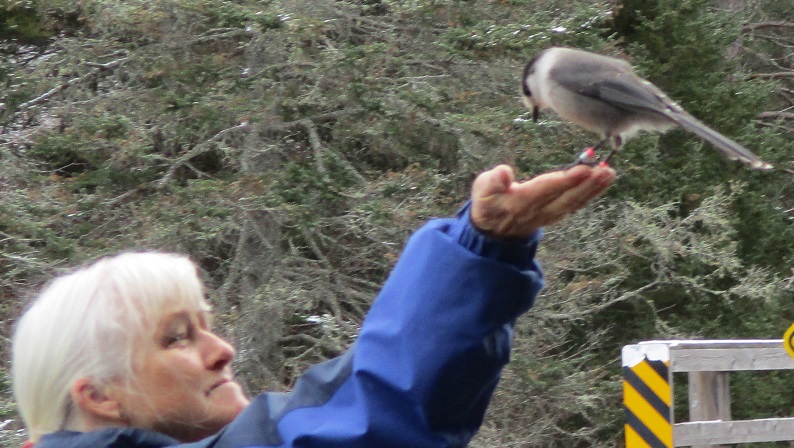
The main interest on these trips is to locate and observe boreal bird species - pine grosbeaks, boreal chickadees and crossbills.  Another boreal bird – the Canada Jay - although not hard to find - is of interest to casual as well as avid birders.  Algonquin is the extreme southern limit of its range.  The last time one of these passerines was seen here in Norfolk County was October 1975.

These birds are unique. They will feed from your hand and a common sight is to see them land on the heads of park visitors at the Spruce Bog Boardwalk. They’re the only birds in the boreal forests that stay on territory for the entire year. Through an astounding ability to store food, the Canada Jay survives long cold winters by living off thousands of pieces of food hidden in boreal vegetation.  Remarkably, research shows that the Canada Jay actually remembers where they’ve hidden food.

For nearly fifty years, most Algonquin Park Canada Jays have been colour banded thereby providing an excellent database on the species. There was a time when they inhabited all the land along Highway 60.  Not now though.

The cause of that decline is almost certainly climate warming.  Warmer temperatures in the park mean that the stored food isn’t lasting as it did in the past.

According to researcher Dan Strickland:

“As global temperatures rise, we can expect that insects, berries, pieces of meat or mushrooms stored by Canada Jays will spoil more rapidly. This will occur even in the winter and may be especially serious when repeated freeze-thaw events accelerate the degradation of perishable food. The cumulative effect of such warming may be that early-nesting (Canada) Jays have less stored food to feed their nestlings than in the past and fewer young jays are produced as a result.” 

Is it possible that a species that resides in all of the provinces and territories and is under consideration as our National Bird will become locally extinct? 

Moose

Back on Highway 60, I’m recalling an encounter with moose from ten years ago - a cow and its calf. (below left)  Although 800,000 people visit each year there isn’t much human traffic in the Park this time of year but on this day this pair attracted a bit of a crowd. Many passersby left their cars to get close to nature thus imperilling themselves and their vehicles.  Experts tell you never approach a moose and stay in your car if observing because they’re big (cows about 400 kg), protective of their young, and can run about as fast as a horse.  

Photo by Graham Wood
Older son Ross got it right that day when he called these wildlife observers “citidiots.” They seemed under the impression that the moose had been placed by the swamp for entertainment as part of some kind of roadside petting zoo. 

One has to wonder whether the ignorance on display that day has some connection to today’s climate warming deniers.  Not as overt stupidity as that practiced by those citidiots disturbing the moose but further evidence that some of us city folk just don’t get it.

Moose populations are in decline in some areas.  The science is tricky.  The latest published Moose Aerial Inventory for Algonquin from 2015 suggests there is a population of 2,655 individuals within the 7,725 square kilometre park.  Not as high as it was, but not bad and, in fact, in density terms among the highest in North America.  But there is danger from winter ticks.  That warmer weather we mentioned is increasing the survival rate of tick eggs.  These ticks actually travel on moose bringing on anemia, fur and weight loss and infection particularly in calves.

The UN Secretary-General recently sounded a warning: 

“Floods, droughts, heatwaves, extreme storms and wildfires are going from bad to worse” and are “breaking records with alarming frequency. They are the price of humanity’s fossil fuel addiction,” declared António Guterres.

These extreme events occupy our attention for a day or two of the news cycle.  We sympathize, shake our heads but comfort ourselves that these calamities are happening somewhere else - not in our back yards. 

Perhaps more subtle changes such as those impacting birds and mammals in our own backyard will be more successful in bringing attention to the impacts of climate change. 

Time’s a wasting!

Thursday, October 28, 2021

CPP Investments Should Divest from Fossil Fuels


Lately I have become involved in a senior’s climate action group called SCAN! https://seniorsforclimateactionnow.org/

We are building a seniors’ group that is democratic, accountable, equitable and participatory. 

SCAN! believes we need decisive action to:

*rapidly drive down carbon emissions and eliminate our dependence on fossil fuels and petrochemicals;

*support those whose jobs have been destroyed by the climate crisis and those whose jobs are  threatened by dramatically reducing carbon emissions;

*begin to restore the ecological damage caused by economic growth; and

*transition from an economy:

        -of accumulation to an economy of sustainability

-of extraction to an economy of stewardship

        -of exploitation and inequality to an economy of fairness. 

One of the initiatives SCAN has undertaken is in the area of Pension Divestment.  Here is a piece that the Chair of our Pension Divestment Working Group penned for the Toronto Star. https://www.thestar.com/opinion/contributors/2021/10/04/seniors-are-calling-on-cpp-investments-to-divest-from-fossil-fuels.html

Recently, I wrote to John Graham, President and CEO of CPP Investments.  CPP Investments is a global investment management organisation that invests the assets of the Canada Pension Plan.  Incredibly, they have actually been increasing investments in fossil fuels, especially the tar sands fuelling the climate crisis! CPP Investments should be showing leadership by investing heavily in renewable energy. 

A copy of my letter is below.  

Please consider sending a similar letter.

Thanks,

Bob Wood

-----------------------------


John Graham, President and CEO 
and Heather Munro-Blum, Chairperson, Board of Directors
CPP Investments
One Queen Street East, Suite 2500
Toronto, ON, M5C 2W5
contact@cppib.com

Dear Mr. Graham and Ms. Munro-Blum,

I am a senior and a beneficiary of the Canada Pension Plan. As I have grown older, I’ve experienced the growing strength of climate change. I am concerned with the force and severity of the weather we now experience. I am devastated at the destruction of our forests and wildlife from forest fires. I am horrified at so many needless, climate-related deaths. I have become increasingly aware of how marginalized and Indigenous communities are disproportionally affected. I worry about the world my loved ones will inherit.

A recent report from United Nations Intergovernmental Panel on Climate Change makes it clear that we must keep fossil fuels in the ground and move quickly to clean, renewable energy. This same body warned us all in 2018 that “limiting global warming to 1.5⁰C would require rapid, far-reaching and unprecedented changes in all aspects of society.” Three years later, but with still little action from the world’s leaders on the climate crisis, the head of the UN has declared that humanity is in a Code Red situation. 

I am very concerned at what I have learned about CPP Investments’ fossil fuel holdings:

• nearly 20 per cent of its Canadian holdings in Alberta, in fossil fuels;

• extensive holdings in U.S. fracking companies;

• coal investments in China, in spite of Canada’s international campaign to transition from coal;

• a major offshore natural gas investment in Ireland.

But most distressing is that that CPP Investments has actually been increasing investments in fossil fuels, especially the tar sands. You are fuelling the climate crisis! You should be showing leadership by investing heavily in renewable energy.

As someone who has contributed to the CPP I am, effectively, a shareholder. My children are contributors and are therefore future beneficiaries. We insist that our money be used to help solve the climate crisis, not contribute to it.

I try to make environmentally and socially aware decisions, whether about purchases, or household energy conservation, for example. I therefore want to ensure the investments that fund my retirement don’t further endanger our children, future generations, and our planet.

As you are responsible for the largest pension fund in Canada, you must ensure that the CPP is funded in keeping with a 1.5⁰C degree of warming. It is imperative that you not make new investments in fossil fuels and that you divest from existing ones by 2025. You must invest ambitiously in renewable energy – which is extremely profitable – and other climate solutions. You must respect the sovereignty of Indigenous people and invest in a just transition for energy workers and their communities. You must stop betting on dubious technologies like carbon capture and storage.

Finally, in keeping with your biannual public meeting’s emphasis on transparency, I want improved disclosure, so that contributors and beneficiaries can see how you invest our money. 

I look forward to your response.

Bob Wood

Copy: divestmentproject@seniorsforclimateactionnow.org