Here is a story that I did (slightly edited) that appeared in a recent edition of Sherman Hub News.
Hamilton Community Legal Clinic/Clinque juridique communautaire de Hamilton is a community based not for profit agency. We provide legal services to low income individuals and communities.
Our goal is to promote access to justice and to improve quality of life. We’ve been asked to make a regular contribution to the Sherman Hub News. This will be our first piece.
At the Clinic we practice what is referred to as poverty law. Put simply, our work is in those areas which disproportionately impact on low-income individuals or disadvantaged communities.
As you can imagine one of the busiest areas of our practice is landlord and tenant law.
We offer information, advice and representation to low income tenants. If a tenant is having a problem with their landlord or rental unit, we can help explain rights and obligations under the law. We can also advise tenants when to get help from another service and how to take legal action to deal with issues. In some cases we will represent tenants at a hearing.
Tenant Advocacy
Another part of the clinic’s mandate is to provide community development, law reform and public legal education. Here case work intersects with advocacy. Over the years we’ve been actively involved in tenant advocacy initiatives. We’ve worked with groups like the Solutions to Housing Action Committee (SHAC), the Tenant Outreach Education and Information Committee and others.
There have been times when tenant work has been relatively well resourced. This is not one of those times. Some of you will remember a group called the United Tenants of Ontario. Many years ago UTOO, as they were known, provided a strong voice for tenants. The group faded away in the nineties. In Hamilton tenant advocacy projects have come and gone over the years.
Left off the List
But that work is important. A recent article in the Citizens at City Hall (CATCH) newsletter hints at why it is.
According to the CATCH story, “(t)housands of Hamilton adults are missing from the city voters’ list and the main cause appears to be long-suspected discrimination against tenants.” (See http://www.hamiltoncatch.org/view_article.php?id=1213)
In Ward 3, where about half of all the housing is apartment or duplex, nearly a fifth (20%) of residents are left off the list.
The omission of tenants is becoming more of a problem. No one comes knocking at your door to put your name on the list of electors any more. Since 1999 enumeration has been taken over by the Municipal Property Assessment Corporation (MPAC). MPAC’s mandate is more about determining property values for taxation purposes than maintaining accurate and updated voters’ lists.
It is not news that tenants need to step up to the plate to represent their own interests. One way to do this is by participation in municipal elections. Historically, municipal politics has been about property and protecting householder’s property values. However, about twenty percent of the average rent payment goes to city hall in the form of property taxes. In addition, much of what gets debated and decided upon at City Hall impacts tenants.
In the 2006 election, the Clinic was involved with an outreach effort called I’m a Tenant and I Vote. We distributed flyers and had a media campaign pointing out to tenants the importance of voting. We had some success when we argued that tenants needed to know how much of their rent went to pay property taxes. Now, the city notifies renters how much they are paying in taxes based on their building’s tax totals. Tom Cooper, who worked at the Clinic at the time, remembers that a tenant in a $700/month unit paid equivalent tax to somebody who owns a $150,000 home.
Another issue we pushed in 2006 was the need to establish appropriate and fair municipal tax rates. We did this because the current system is not fair. Multi-residential taxpayers pay nearly three times the rate of residential (single unit) taxpayers. Tom Cooper, now with the Hamilton Roundtable for Poverty Reduction, documented that reality in a story in Raise the Hammer. (http://www.raisethehammer.org/article/577/tenants_and_taxes)
A city committee looked into this but nothing has changed. With the municipal elections less than a year we’re concerned that tenant voices won’t be heard.
What can be done?
Some municipalities are taking the issue seriously.
As the CATCH story points out:
“Toronto has recognized the voter participation shortfall among tenants and taken specific steps to tackle it, including locating nearly half their polling stations inside or within 800 feet of an apartment building. That was partly in response to a campaign calling for a polling booth in every apartment building that has more than 100 units.”
A campaign like that needs to happen here. Perhaps the neigbourhood hubs can take a leadership role in addressing the voter participation shortfall. The Hamilton Community Legal Clinic will help.
Saturday, December 14, 2013

Sunday, November 17, 2013
"Transit Talk"
I’ve heard that there have been significant changes to Burlington
Transit routes. Living well outside the
GTA/Hamilton, as I do now, it is hard to keep track. This week I got a better idea of what the
changes entail.
On the positive side James talked about improvements that Mississauga is making with a Transportation Demand Management (TDM) program. In one year, they achieved a significant reduction in car trips.
TDM is a term used to describe strategies that improve transportation efficiency. TDM emphasizes the movement of people and goods rather than motor vehicles. The term Mobility Management is now replacing TDM as a more useful descriptor. (Learn more about Mobility Management at http://www.vtpi.org/tdm/tdm51.htm)
There is a new schedule for one. That is the third new schedule in 2013. That doesn’t bode well for riders and
businesses looking for some consistency in planning how to get around.
I listened to a tape of the CFMU show Unusual Sources where the Transit Talk show presented a discussion
on some of these changes.
As far as how these changes are being promoted Transit
Advocate James Smith put it this way:
“They are saying the right things but when the rubber hits
the road that’s just not the case.”
Fairview/Plains enhancements are a good thing but, as host
Doug Brown pointed out, they are offset by reductions elsewhere. Burlington Transit’s extremely small fleet of
52 buses now covers 33 routes.
One of the most surprising changes is the elimination of
Mapleview Mall as a pick up and drop off point for BT routes. On the positive side James talked about improvements that Mississauga is making with a Transportation Demand Management (TDM) program. In one year, they achieved a significant reduction in car trips.
TDM is a term used to describe strategies that improve transportation efficiency. TDM emphasizes the movement of people and goods rather than motor vehicles. The term Mobility Management is now replacing TDM as a more useful descriptor. (Learn more about Mobility Management at http://www.vtpi.org/tdm/tdm51.htm)
Perhaps Burlington could learn something from Mississauga.
You can find the CFMU show (it lasts about 20 minutes) by
clicking here http://www.soundclick.com/bands/page_songInfo.cfm?bandID=726427&songID=12571313&showPlayer=true
Saturday, November 09, 2013
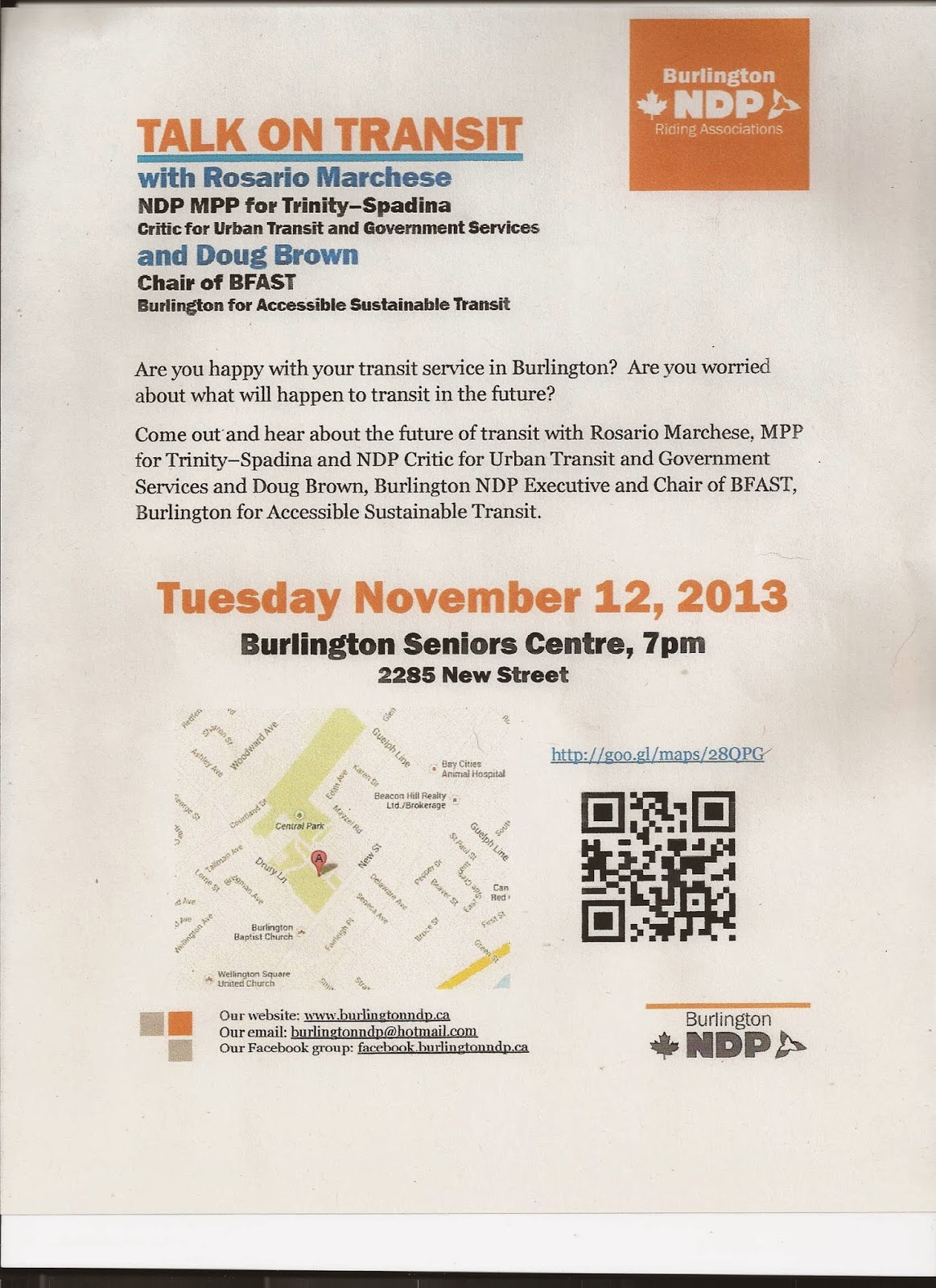
TRANSIT FORUM
Are you happy with your transit service in Burlington?
The Burlington NDP wants to know. They are hosting a meeting Tuesday (November 12th) at the Seniors Centre in Burlington to discuss this issue.
A couple of speakers will lead the discussion.
One speaker is Rosario Marchese, the NDP MPP from Trinity-Spadina. Marchese is a long time MPP first elected in 1990 and re-elected five times since then. He is the party’s Urban Transportation and Government Services Critic and Caucus Chair.
Marchese speaks English, Italian and French and is conversant in Portuguese and Spanish.
Here is Marchese speaking on the need for a strong Metrolinx with a clear vision for transit and transportation. http://www.youtube.com/watch?v=-CKHgKLhpT8
The other speaker is Burlington’s Doug Brown, the Chair of Burlington for Accessible Transit (BFast). I don’t think there is anyone more knowledgeable about Burlington Transit than Doug is.
Here is a video that was put together by Graham Wood a couple of years ago where Doug talks about some of the issues facing Burlington Transit. There is even a picture of the Pier before it was complete in this video for those who have forgotten what that looked like.
http://www.youtube.com/watch?v=Z0GbertmAUg
As Burlington decision makers continue to make cuts to the transit system I’m hoping this meeting will help give voice to those who know how important public transit is for a community.
Sunday, November 03, 2013
Oakville Transit Fare Increase
All we want are the facts, ma'am"
Joe Friday
Making decisions in municipal politics and in all facets of life, I suppose, requires having some facts.
Some politicians, Rob Ford comes to mind, just make these facts up.
Others seem to have an incredible ability to absorb and /memorize relevant bits of information and pull them out when necessary.
Most municipal politicians depend on staff to gather and present these relevant facts so that that policy decisions can be made by the policy makers and the rational for those policies be understood by the public.
It goes without saying, then, that the facts need to be accurate. With that in mind the Crack Research Team (CRT) here at When the Mayor Smiles was deployed to look at the following statement contained in a recent Town of Oakville Media Release.
"Oakville Transit fares, even with the proposed changes, continue to be among the lowest when compared to other similar sized transit agencies in the GTA."
Oakville staff are proposing to change i.e. raise fares. If approved the new rates will be:
$3.50 for a cash fare
$105 an adult monthly pass
and $50 for a Monthly pass for those over 65.
With these new rates will Oakville continue “to be the “among the lowest?”
CRT has compared prices around the GTA. We’ll leave out Hogtown. By our count we’ve got Brampton, Burlington, Durham, Mississauga Oakville and York to look at.
Comparing the cash fares of these six properties and using Oakville’s proposed new fares we find the average cash fare is $3.39. That’s lower than Oakville’s proposed $3.50. In fact, only York has a higher cash fare.
As far as monthly adult passes Oakville’s proposed new rate ($105) is below the average of $109.67 and their seniors’ monthly pass is right at the average of about fifty bucks.
But the media release talked about “similar sized transit agencies in the GTA.”
In our view, the comparator group drops down to Burlington and Durham as Brampton, Mississauga and York are all much larger than Oakville. Two is hardly much of a comparison. So let’s look at the seven other Ontario cities closest in population to Oakville.
They are Kitchener, Windsor, Richmond Hill, Burlington, Greater Sudbury, Oshawa and Barrie.
Average cash fare for the seven is $3.05.
Oakville’s proposed cash fare is $3.50
Average adult monthly pass for the seven is $89.91.
Oakville’s proposal is for $105.00
Average monthly senior pass for the seven is $50.86
Oakville is $50.00
We conclude, then, that Oakville’s current fares would seem to be more in line with similar places. The proposed increase would make them among the more expensive.
Transit advocate Doug Brown reminds us that this is not the first time fares and costs have been “misrepresented” to justify higher fares in Oakville and Burlington.
“In 2010 both Burlington and Oakville used the downloading of Halton's financial contribution to GO from the Region to the lower tier municipalities to create the false impression that there had been a large increase in local transit spending,” Doug notes.
Of course, decision makers need to look at more than just fares. The quality of the service needs to be factored in as with any product your purchase.
I wonder, is the service improving?
Friday, October 11, 2013
Tenants Benefit from Quickest Ever Class Action Resolution
A class action
lawsuit launched against Toronto Community Housing and Greenwin Property has
been settled.
Read the Toronto Star story at http://www.thestar.com/news/crime/2013/09/30/200_wellesley_st_fire_600_tenants_to_share_in_485m_compensation.html
“Class actions are lawsuits in which
the claims and rights of many people, defined as having common but no
identical interests, are decided in a single court proceeding brought by
representative plaintiffs, or representatives of the class.” (See http://www.classaction.ca/about-siskinds.aspx for more about
class action lawsuits)
The action came
about following a fire that took place on September 24th 2010 at 200
Wellesley East in Toronto.
Six hundred tenants
will share 4.85 million dollars to compensate for property damages and
injuries.
The fire was
caused after a discarded cigarette landed on the balcony of a 24th
floor unit. That unit had an excessive
amount of combustible material on it.
The unit’s occupant, who was identified by investigators as a hoarder,
had previously complained to property management that someone was tossing
cigarette butts on his balcony.
It is reported that the case is
the fastest to be resolved in Ontario history.
The Ontario Class Proceedings Act came into
effect twenty years ago. According to Brian Shell, lawyer for the
tenants:
“It was designed
to bring access to justice to people who otherwise would not be able to get
any,” Shell said. “It was not designed for lawyers to make huge amounts of
money and for many thousands of people to recover $40,” Shell told the Star.
Read the Toronto Star story at http://www.thestar.com/news/crime/2013/09/30/200_wellesley_st_fire_600_tenants_to_share_in_485m_compensation.html
Tuesday, September 17, 2013
Court Won't Hear Right to Housing Challenge
Earlier this year I wrote
about how social and economic rights are becoming increasingly important. http://whenthemayorsmiles.blogspot.ca/2013/02/social-and-economic-rights.html
In that piece, I made
reference to the “right to housing.”
Recently we had a case in
Ontario where the idea of federal and provincial governments were challenged from
that perspective. Here is what
happened.
(This story originally appeared on www.hamiltonjustice.ca)
--------------------------------------------------------
Ontario Superior Court Judge Thomas R. Lederer ruled on Friday that the courtroom is not the proper place to resolve the issue of homelessness and inadequate housing in Canada.
Ontario Superior Court Judge Thomas R. Lederer ruled on Friday that the courtroom is not the proper place to resolve the issue of homelessness and inadequate housing in Canada.
The Judge’s comments came in a
decision in, what has been called, the Right to Housing Challenge. Individuals
and housing advocates were trying to make the case for a court order. That
court order would require that the Federal and Provincial governments implement
a national housing strategy.
Lawyers from the Centre for
Equality Rights in Accommodation (CERA) and filed a case three years ago. Their
argument is that Canada and Ontario have violated individuals’ rights under
section 7 and section 15 of the Canadian Charter of Rights and Freedoms by
creating and maintaining conditions that lead to and sustain homelessness.
Put simply, Canadians have the
right to adequate, affordable housing.
Lawyers for the governments of
Ontario and Canada argued that the case shouldn’t even be
heard.
heard.
Judge Lederer agreed with the
government lawyers.
Peter Rosenthal, one of the
lawyers for the applicants, offered this comment:
“The decision reflects a
narrow view of the Charter that seems to be applied when the poor seek judicial
relief.”
The judgment will be appealed.
You can read more about the
Right to Housing Challenge on the website of the Advocacy Centre for Tenants of
Ontario (ACTO) at http://righttohousing.wordpress.com/
Wednesday, September 04, 2013
Physician Believes Poverty Reduction is Essential for Good Health
(This story originally appeared at www.hamiltonjustice.ca on August 19th.)
This gathering is put together for Community Legal Clinic staff who are involved in and want to learn more about community development work.
One of the really interesting speakers at this year’s conference was Dr. Gary Bloch.
Gary is a family physician who works out of St. Michaels Hospital in Toronto.
His presentation focused on the social determinants of health. The twenty-minute talk zeroed in on one particular social determinant of health – i.e., poverty. Gary told us “poverty accounts for 24% of person years of life lost in Canada.” That figure is second only to 30% of person years of life lost for cancers.
One significant resource Bloch made us aware of was a four pager called a Clinical Tool for Primary Care in Ontario. This is a resource for family docs that will help them in patient diagnosis. It will help physicians to keep in mind that poverty is a health condition that needs to be treated like other medical conditions. (http://www.ocfp.on.ca/docs/default-source/cme/poverty-a-clinical-tool-2013-(with-references).pdf?sfvrsn=0 )
Bloch has a unique approach to practicing medicine. In a Globe and Mail story, he wrote earlier this year emphasized the importance of tax filing. http://www.theglobeandmail.com/commentary/as-a-doctor-heres-why-im-prescribing-tax-returns-seriously/article9981613/
A patient named Rena told Bloch he could make her better by getting her more money. But Gary determined that Rena had not always filled out her tax return.
“Suggesting Rena fill out her tax return is prescribing income. And prescribing income can be just as powerful as prescribing medications for her blood pressure or her mood,” wrote Bloch.
Bloch wrote about another patient in a story in the Huffington Post. http://www.huffingtonpost.ca/gary-bloch/income-inequality-and-health_b_2003259.html
Tom is a 46 years old skilled carpenter who hurt his back in a car accident 8 years ago. He has been forced to live on social assistance.
“For him, social assistance has not been so much a safety net as it's been a fish net -- a trap of indignity from which he has been unable to wriggle free,” said Bloc.
Similar to the views of the Clinics, Bloch believes that there should be a level of social assistance support that allows for a dignified standard of living.
“Forcing people to live in squalor and survive on less than a pittance only worsens the health impacts of their low income. While this may appear to save money up front, it likely ends up being spent elsewhere, through higher use of physical and mental health services down the road.”
While Gary Bloch views may stand out as unique for a physician, the ground is shifting in the Canadian medical world. The Canadian Medical Association has just completed a consultation. Their conclusion is that poverty is the main issue that must be addressed to improve the health of Canadians.
Subscribe to:
Posts (Atom)