Tuesday, January 26, 2021

One Minute Review


Finding  Murph

Rick Westhead

Harper Collins, 2020

First-rate story about an NHL star victimized by the league’s failure to recognize the long term impact of concussions.

Focusses on Joe Murphy who won an NCAA championship with Michigan State and a Stanley Cup with Edmonton. The 1986 first draft choice played 779 regular games over 15 NHL seasons (233 goals & 528 points) adding 77 points in 120 playoff games.

Sure Joe was a different kind of guy affectionately described by teammates as “odd,” and "an airhead” but when he took a hit to the head on Jan 9, 1991 and things changed.

Westhead strengthens his thesis through access to many documents and e-mails previously under seal with US courts in connection with a concussion lawsuit.

The e-mails reveal the league’s mindset.  Medical people who warned of long term damage were “dumbass doctors” just putting out “imbecilic rants” with “no idea what they are talking about” because, of course, they had never played.

They were “tree huggin…leftist doctors… that soon won’t let us climb stairs for fear of concussion,” wrote the NHL’s director of officiating.

We “view ourselves as a family” said NHL Commissioner Bettman, who called any evidence of concussion brain damage anecdotal.   What family would reject care of a loved one by denying the science?  “No conclusive link,” Bettman would say as recently as 2019.

Meanwhile, Joe Murphy is homeless in Kenora (when the book ends) and apparently still today in Saskatchewan.

Like Ken Dryden’s Game Change Westhead’s book is a clarion call for the sports world to take concussions more seriously.


Monday, January 11, 2021

Looking for Authentic Voices


Some years back when Jean Chretien was the Prime Minister of Canada a man attended the leadership convention of a Canadian political party.

It is a little-known fact that of countries with a parliamentary system of government, Canada is the only one that has taken on a form of the American national party convention as a way to choose its leaders.  The first such convention was held in Canada in 1919 in Ottawa.
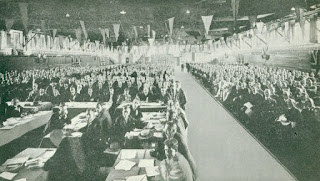
1919 Liberal Convention - Landsdowne Park, Ottawa from Library and Archives Canada
Liberal Convention 1919 - Library Archives Canada

Put simply a leadership convention is one where party members chosen as delegates convene and choose a leader by voting.     

 This man, William, was not an important player at the convention – just an ordinary delegate, one of about 1,500.  

Policy debates took place and the leadership candidates gave speeches and hosted hospitality suites. Then came the voting for a new leader.

The candidate who William supported was ahead after the first ballot. According to the rules, the candidate who finished last on the first ballot was eliminated.  His elimination meant that his supporters could now vote for one of the other candidates on the second ballot.  

During the time before the second ballot voting began there was much excitement.  Music played, delegates marched and danced around the hall chanting and calling out for others to support their favoured candidate.  The major television networks captured the contrived hoopla of modern-day democracy. 

Together with other delegates William sashayed around the room carrying the sign of the candidate who he had supported on the first ballot.  As he made his way somewhat self-consciously around the perimeter of the hall, a young volunteer organizer for the leading candidate offered him a sign belonging to the eliminated candidate.  William recognized the young woman as she was an active member of his local riding association. In fact, at the last riding association meeting she had successfully presented a motion that advocated for the establishment of a proportional representation system of voting.

William took the sign and continued to march around the hall displaying the signs of two candidates. Those watching might assume that he was now shifting his vote from the eliminated candidate to the leading one.  To people watching this all seemed very authentic.  In truth, William did not particularly like the eliminated candidate and had not voted for him.  

However, in the hall many people applauded William.  To them, this delegate seemed to be holding up well even though he must surely be disappointed that his candidate had been eliminated. For them this man was making a wise choice for his second ballot vote.  

William considered himself to be a truthful person.  Most people who knew William would confirm this. And it was certainly not a lie when he took up the second sign. However, he felt some slight amount of guilt for his actions.  He wasn’t destroying opponent’s election signs or selling bogus memberships or anything malicious or illegal  but his actions were not authentic ones.

For centuries philosophers have explored the concept of genuine authenticity in public life.  It is considered an essential attribute of modern democracies.   But as time wears on the concept of authenticity is eroding faster than the Athabasca Glacier. 

Several years before this convention William had been a reluctant candidate for public office. He was persuaded to run at the last moment when the previously nominated candidate had been offered and accepted a job in the public service as a Communications Specialist.

While William knew the issues, he wasn’t a good public speaker, didn’t know how to work a room and thought that knocking on people’s doors was an invasion of their privacy.   William believed, not surprisingly, that these were serious shortcomings for a candidate for public office.  Somewhat like a vegan suddenly being put in charge of grilling at the service club’s annual ribfest fundraiser.

“Don’t worry,” he was told.  “Just be you.  Be true to yourself. That’s all you need to do.”

William passed this advice on to his long-suffering wife, Ruth.  Ruth wasn’t terribly interested in politics.  She wasn’t sure if “being yourself” was the best advice in her husband’s case but she always encouraged him in his endeavours.

“Yes, go ahead run. Be yourself, but be restrained in doing it,” she advised.

The riding association had apparently done some preliminary polling and William had scored fairly well for someone who was not well known.  William was also encouraged by this polling but wasn’t sure why.

While he hadn’t been elected, hadn’t really come close to winning in fact, William had knocked on many doors and had presented his party’s platform ideas to the public as he was expected to do.  Much to the consternation of William’s campaign manager, who didn’t want the candidate to spend an excessive amount of time at each house, William also listened to those people who answered their doors and made an effort to appreciate their concerns.  William found it noteworthy that their concerns were not in line with what his party and the other parties were talking about.  The parties were talking about national unity, Arctic sovereignty and trade agreements. But the people William talked to were more interested in jobs, plant closings and whether they’d be able to swim at the lake this year.  

Something was happening in town. Not a noticeable overnight change but a gradual move in thinking that politics and politicians didn’t have the answers to today’s problems.

People were disillusioned with public institutions.  They were looking inward and opting out of being involved with the broader community, although they were doing this reluctantly, William thought. 

At the time, William read reports from experts who had identified this trend.  These experts believed that many people felt they had no voice in their government.  So, they were falling back on themselves and beginning to explore personal “authenticity” that was unconnected to the wider community.

To William this was just a long-winded way to say people were becoming disengaged with government and their communities.

Of course, William knew nothing about social media when he had been a candidate and at this particular convention as these events pre-dated the advent of this new technology.  Later, as social media matured, experts would assert that social media offered the potential of genuine authenticity.

For her part, the young organizer who had passed the sign to William continued in a career where she advocated for progressive policies. 

It was her belief that as social media evolved it would offer regular people the opportunity to speak their minds unencumbered by commercial media constraints.  After all, what could be more authentic than an individual, independent blogger or Facebook user speaking out on whatever s/he thought needed to be said?

The organizer was hard working, idealistic and committed.  Working in the non-profit sector she learned how to use social media to promote causes important to her.  She returned to the political world around the same time that politicians discovered how to manipulate social media for their own selfish purposes.

Like the young organizer and the man at the convention, the politicians and their advisors thought strategically.  But their thoughts were on a larger scale, a much larger scale. 

They recognized that blogs, Twitter and Facebook provided an opportunity to present the “real and authentic” side of politicians.

In order to learn from these political experts, the young organizer, Jennifer Taylor, was sent for training at the School for Democratic Political Organizing.

Jennifer took a train to the city.  She was most eager to learn from the trainer, who was himself an experienced organizer, as well as others who would be attending.

The trainer was well prepared and professional looking.  He was dressed in trousers, a button-down shirt (good for accommodating a lavalier), a tie, and jacket. He followed the trainer’s technique book by dressing one level up from the trainees.

The trainer used pithy dialogue and appropriate and up to date presentation materials. 

His case for authenticity went along these lines.

The politician needs to be seen as a genuine person.  The voters need to understand that s/he is one of the people – someone with whom you would enjoy having a beer; someone you could trust to babysit your kids.

Through the use of appropriate social media your candidate can reach voters with a message that you will be able to deliver in a clear un-edited way.  And, by doing this you will bypass the fallacious fourth estate, he said.

The trainer shared a list of ten tactics that must be incorporated into every social media strategy.  Number 6, the Lyndon Johnson “make-em-deny-it maxim” stood out for the organizer.

It has long been reported that, during a Texas election, Lyndon Johnson, the 36th President of the United States, ordered aides to put out a rumour that his opponent, a former pig farmer, was amorous with the farm animals.

When Johnson issued this order an aide responded, “We can’t prove that.”

I know, Johnson apparently replied.  “I just want him to deny it.”

So here is how “make-em-deny-it” works today in the world of social media.

A candidate who you oppose makes a statement. Put out your own response.  It doesn’t need to be totally accurate.

Now this means there will be at least a couple of points of view out there. You need to do this as soon as you can. If you are skilled in putting that piece out it will go viral before it can be fact checked. 

Members of the public, reporters, journalists, and bloggers won’t have the time or ability to verify claims. By the time they do, if they do, your story will have become embedded in the public’s mind.

“But this is wrong,” the young organizer interjected.  

“How is that,” responded the trainer?  It seemed he was ready for an argument.

“This challenging of real facts with half truths, half baked conspiracy theories and misinformation just makes the public more cynical.”  

“Look Ms. Taylor.  Are you in this to win debating points at the Socrates School of Ethics or are you in this to win?”

The trainer explained that studies have been done that tell us that if people go after the information that you’ve put out by directly trying to refute it; they may actually have the effect of spreading your information even more.  

“In other words, it works.”

So, the lesson in authenticity that the organizer would take back to her constituency was in fact about an authenticity that should be carried out as a strategy. It was not really a genuine authenticity.  Genuine authenticity was a goal that Jennifer thought all individuals should pursue. 

The organizer left the training somewhat disillusioned but returned home confident that in her constituency work she and her other campaign volunteers could manage their social media in a way that would be authentic and not a phony strategy like the one advocated by the trainer.

Not surprisingly, she bumped into that man who she had handed the sign to at that long-ago convention.  He was involved with Jennifer and others on the election planning committee for their local candidate. William had been doing some reading on campaign strategies used by the President of the United States.

“Look at that guy down in the White House?  He lies all the time.  But a lot of people will tell ya he seems authentic. I don’t get it.  Do you?

The young organizer took a deep breath.  “Hmm.  Well, those people you are referring to believe he says what he means.  He is not like all those regular politicians. That’s what they think, anyway.”

“But what he says isn’t true most of the time.”

“He doesn’t worry about that.  He lies authentically and somehow it works.”

The two shook their heads, wondered what was becoming of the world and how all of this would impact their local campaign.

Then two days before the election was called the independent, non-partisan agency of Parliament responsible for overseeing elections made the following announcement.

“Due to interference in our social media by foreign powers we have made the difficult but necessary decision to make it illegal to use social media during the upcoming election. Any candidates, political parties and third parties engaged in election advertising will face heavy fines and possible jail time for infractions.  Only through these actions will we be able to ensure the authenticity of our elections.”

At the campaign team meeting the day after the announcement William and Jennifer and the rest of the team were worried.  They had spent months organizing their campaign and it was heavily dependent on the use of social media. 

“What will we do now,” Jennifer asked the assembled volunteers?

There was silence.  The new rules on social media had come as a big surprise to everyone.

Then from back of the office came shuffling noises. It sounded like someone was struggling with an awkward load as they tried to enter through the back door.  Soon, William’s diligent wife Ruth entered the room.

“I’ve been clearing out junk, old papers and the like out of William’s so-called home office and came across these boxes of campaign strategy books from the 1991 election.  Are they of any use?”

The volunteers all turned to look at Jennifer Taylor.  Jennifer smiled serenely.

“Well Ruth, the answer is yes.”

Postscript

And so Jennifer’s team ran what they believed to be an authentic campaign. They worked hard to engage with voters in honest face to face dialogue. Their advertising and promotional material emphasized the positive aspects of their platform and did not mis-represent their opponent’s positions.  While other campaigns found a way around the restrictions on social media, Jennifer avoided its use. They failed to win the riding although they did significantly better than in the past.

People noticed what this campaign was doing and there was praise for it.

The only remaining newspaper in town even editorialized about Jennifer’s team’s campaign calling it a return to what politics should be all about – an authentic politics.  

-----

Looking for Authentic Voices was published last year in Literature for the People (Editor Raymond Fenech).


Thursday, December 31, 2020

A Good Walk Perfected


Sometimes I wonder whether what I’ve written is relevant.  Perhaps at a point in time a piece was newsworthy or interesting.  However, time and current events often catch up and leave your piece as something to be filed under “P” for passed its best before date.

However, this story, basically a report on a presentation on birds and birding, seems more relevant today that when I put fingers to keyboard back in May of 2014. 

----

It has been said that golf is a good walk spoiled.

But birding is “a good walk perfected.”  That was the message Jeff Gordon brought recently  to a large group of outdoor enthusiasts at Bird Studies Canada’s (BSC) National Office in Port Rowan just about 400 metres from my residence.

Yes, we have a National Office in Port Rowan. And Gordon, a celebrity in the birding world was a most able and appropriate speaker as spring migration is ramping up here on Ontario’s South Coast.

Gordon heads up the American Birding Association (ABA), a non-profit organization that provides leadership to North America birders and also contributes to bird and bird habitat conservation through its programs.

He was in town to participate as the Celebrity Birder in the annual Baillie Birdathon as well as to speak at this special event billed as a Celebration of Birding.

Gordon is passionate about birding and birds.  He worries, though, that birders need to open up to others who may be interested in nature and the outdoors but are intimidated by the vast knowledge many experienced birders present.  Rather birders need to be “evangelists” about their hobby and help “break down barriers” for newcomers.

Gordon’s presentation included plenty of action shots of birders from around North America including Alvaro Jaramillo. (Jaramillo coined the “good walk perfected” line.)  The ABA head takes these types of pictures because birders are good at taking photos of warblers and eagles and the like but not so good at taking pictures of people enjoying birds.  More images that capture the “grandeur of birding” are needed.

Earlier in the day, local ornithologist Tim Lucas found a rare Kirtland’s Warbler near the entrance to the new Long Point Provincial Park.  This is considered North America’s rarest warbler and is normally found only in a small area in the north central part of Michigan’s Lower Peninsula during breeding season.

Gordon and a dozen or so others were there.  He captured the excitement on his smart phone and shared the footage in the evening presentation thereby reinforcing his key message.

I think Gordon made his point well that night.  The next day another relatively rare bird was located in the area.  Check out this picture from Jody Allair's twitter account and you should be able to share in the enthusiasm with those seeing a Bell’s Vireo for the first time.


-----

This story was originally published by Forever Young, a Metroland paper.


Update:

**In 2020 Bird Studies Canada changed in name to Birds Canada.  That change is recognition that their work extends beyond the study of birds and encompasses “public engagement, habitat stewardship, education and training, involvement in guiding conservation decisions, and more.”

**If you’re not doing anything on New Year’s Eve, join the American Bird Association (ABA) as they announce the new Bird of the Year at midnight St Pierre et Miquelon time (10 pm EST)


Monday, December 28, 2020

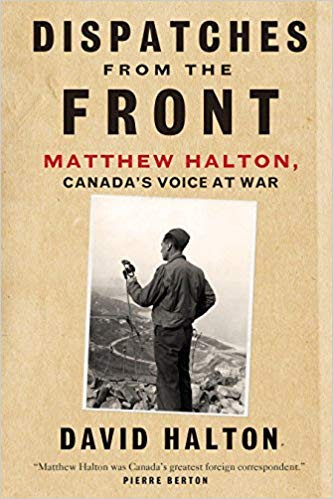
Dispatches from the Front*


“Call them out ... Dunkirk, Tobruk, Alamein, the delaying action in Burma, the last stand at Sollum… Call them out, and then add Moro River …

The attacking Canadians beat two of the finest German divisions that ever marched.” 

Matthew Halton reporting from the ruined town of Ortona, where 2,400 Canadians were killed or wounded. December 28, 1943

------

David Halton begins his book Dispatches from the Front with a story from 1987. The author recalls a journalism student heading into the CBC Archives to research an individual she and most of her classmates had never heard of. That would be Halton’s father, Matthew. Matthew Halton is considered to be one of the best war correspondents of World War II.


In his preface, David Halton describes his father as “a more or less forgotten name for all but survivors of the war-time generation.”

I’ll admit to knowing very little of the Toronto Star/CBC journalist. Several years ago I heard a tape of some his dispatches. The reports were riveting and the reason I put Dispatches on my must read list.  I re-read it earlier this month.

Halton, the son, has written an extremely well researched, objective memoir 

of his famous father. It helped fill in some holes in this baby boomer’s understanding of the Depression and Second War history. 

Here are a few facts I gleaned from the book.

1. In a two-month period in the fall of 1933 Halton wrote 30 reports from Germany. Now known as the German Reports, they “chronicled almost every defining aspect of Nazi Germany.” They told truths that most other media were ignoring. Halton held back most of these reports until he was out of the country in order to avoid the harassment from authorities that other journalists were experiencing.  For example, on Oct. 16 he wrote: “Germany is literally becoming a laboratory and breeding ground for war, unless I am deaf, dumb and blind.”

2. Later that October, Halton observed: “The terror goes on unremittingly in the form of a deliberate and implacable intention to wipe the Jews out of the economic and social life of Germany.” 

3. Beginning in 1936, Matthew Halton was critical of then Chancellor of the Exchequer (Finance Minister) Neville Chamberlain who was later to be Prime Minister. By December of 1939, Halton called for new leadership “who has not only cool determination but also some high strategic vision.” In his view, that new visionary leader was Winston Churchill. Halton’s viewpoint was a controversial one. Churchill had many critics including Mackenzie King. In a diary entry, our Prime Minister described Churchill as “one of the most dangerous men I have ever known.”  King who had an extended 75 minute meeting with Hitler in 1937 described the German dictator as having a very nice sweet (smile) and as “one who truly loves his fellow man.” 

4. But Matthew Halton wasn’t always right in his analysis. For example, Halton   was sympathetic to the Republican cause in the Spanish Civil War. Perhaps too sympathetic. The war correspondent gave undeserved credit to Barcelona authorities for giving fair trails. However, as the younger Halton notes: “Organized religion was banned in Barcelona and hundreds of priests were summarily executed in Catalonia and dozens of churches burned down.” 

5. Matthew Halton interviewed and/or hobnobbed with many of the most famous people of the time. They included Albert Einstein, Haile Selaise, Gary Cooper, Paul Robeson, Lord Beaverbrook, Grey Owl (Archie Belaney) and the Prince of Wales (later King Edward VIII) to name just a few.

6. Interestingly, we learn that Halton never interviewed Churchill, as the British politician “saved his insights for newspaper articles, which paid him well.”


7. While seldom there, Matthew Halton was proud of the fact that he hailed from Pincher Creek, Alta. Talking in a London nightclub with the Prince of Wales less than three years before he became king, Halton was impressed with the prince’s “informality and desire to shed the stuffier traditions of the monarchy” as well as Edward’s love of the Alberta foothills. The Prince owned EP Ranch near Pekisko Creek, only 150 kilometres from Pincher Creek.

8. Unlike some war correspondents, Matthew Halton actually reported from the front lines. In the desert war in Alamein, with the Canadian forces landing in Sicily, D-Day and many other theatres of war, Matthew Halton was in the thick of it.

9.  The CBC required that sound could not be dubbed in with a voice track unless the reporter had actually been at its source.  That made Matthew Halton’s coverage unique and “more authentic… than some radio and television war reporting today,” wrote David Halton.

----------

*Dispatches from the Front Matthew Halton, Canada’s Voice at War by David Halton is published by McClelland & Stewart.


Tuesday, December 22, 2020

Rupert Hotel Fire - 31 Years Ago


Wednesday December 23rd marks the 31st anniversary of the terrible fire at Toronto’s Rupert Hotel.


This past November the City of Toronto took steps to come up with new regulations that would be part of a comprehensive city-wide regulatory framework for multi-tenant houses.  


These regulations would be developed using a human rights lens thus “ensuring regulatory oversight to protect tenant life safety and create liveable,  well-maintained and affordable places to live.” 


You can read a report that talks about this process at http://app.toronto.ca/tmmis/viewAgendaItemHistory.do?item=2020.PH18.2 


This is good news.  Hopefully new polices will be in place soon. 


Meanwhile many in our province continue to live in perilous and dangerous conditions like those that I wrote about last year in Rupert Hotel December 1989*. 

---------------


                         Rupert Hotel December 1989*


         Gordon was sorry

         but it was tough keeping warm

         and he’d had some to drink 

         so setting fire to those papers on the floor in the middle 

         of his second-floor room made some kind of sense.


         At the Rupert Hotel, a three-storey brick walk up 

         in a licensed city rooming house 

         off Queen Street East 

         at Parliament

         those with few options and few dollars could exist, 

         in a way. 


         Gordon’s warming fire soon leapt out of control 

         flames and choking smoke filling the corridors 

         as the fire gained full possession of the hallways.

         The license pinned to the wall wasn’t worth the paper 

         it was printed on as far as the protection it afforded 

         the 31 tenants at the Rupert

         on this wintry December night. 


         A sprinkler system might have halted the fire’s progress.

         Perhaps tenants could have taken action 

         if the alarm system had been operable 

         or fire extinguishers stored in the basement were reachable.


         It was 17 long minutes before someone called 911.

         When firefighters arrived 

         the whole building was enveloped. 

         Flames leapt out of the top floor windows.

         Firefighters using ladders forced their way 

         into the searing heat of the second floor.  


         Later a witness called it 

         “A Vision out of Hell.”

         As the fire raged people screamed, crying out for friends.

         It took six hours and eighteen crews to subdue the blaze.

         Thankfully, some tenants were saved and many escaped. 


         For days crews chopped through ice and debris to locate bodies. 

         They found nine men. 

         A woman had returned to the building to help a friend 

         Donna Marie Cann died, as had the others, 

         of heavy smoke inhalation.


        Soon an inquest was held.

        Recommendations were made    

        new rules created 

        regulations established

        housing planned.


        After a while all was forgotten.

        Rules and regulations lapsed, 

        were ignored or opposed 

        and the programs ended.


        In the city today austerity policies 

        compel people to rent rooms 

        in perilous and dangerous buildings. 

        Many flee the downtown to illegal suburban homes 

        where life is cheaper.


*According to the Fire Marshal, there were fires at 69 illegal rooming houses in the Toronto area between 2013 and 2017.

----------


Rupert Hotel December 1989* was published earlier this year in Literature for the People (Editor Raymond Fenech) and received honourable mention in the Norfolk Literary Prize competition.


Monday, October 19, 2020

Reforming Social Assistance - Evidence Based Rates

Of course, we need social assistance rates that have some connection to the cost of living.  Here is a story I wrote and posted on my blog on that topic nine years ago.  I’ve updated it slightly.

------
In the mid-nineties Mike Harris’ government reduced social assistance rates in Ontario by 22%. 

There was no economic rationale for this move – just a stupid, mean spirited, ill informed attempt to make social assistance rates unattractive.  By doing this it was presumed that to people would find jobs that didn’t exist or that they weren’t qualified to do.

In addition, getting on to social assistance was made much more difficult as people were forced to reduce their assets before qualifying.  What kind of reductions?  Well, today (2011) a single person applying for Ontario Works is permitted to have a maximum of $592 in assets in order to qualify so that they can receive a maximum of $7,104 annually.

The issue of inadequacy of social assistance rates must be addressed.  At the Hamilton Community Legal Clinic, where I work, we believe that social assistance rates need to have some relation to the actual cost of rent, food and other basic necessities in communities across Ontario.

A few years ago the Clinic, with the leadership of staff lawyer Craig Foye (pictured below) drafted legislation that proposed the idea of setting up an expert panel that each year would recommend evidence-based social assistance rates to the Provincial Government. “An Act to Establish the Ontario Social Assistance Rates Board” (Bill 235) was introduced for first reading as a private member’s bill in the Ontario Legislature by MPP Ted McMeekin on June 4, 2007.


Unfortunately, the Legislature was then prorogued the next day in anticipation of a fall election, meaning the Bill was effectively discontinued. The Bill has not yet been reintroduced. Since that time the Clinic and others have continued to advocate with government to implement a process for determining evidence-based social assistance rates.  

 The Clinic has advocated for: 

an arm’s length body to recommend evidence-based social assistance rates on an annual basis. Those rates should be based on an analysis of the actual costs of rent, a healthy food basket, and other basic necessities in communities across Ontario, and should provide a level of assistance that will allow individuals and families to live with dignity. An example of such a body is the Ontario Social Assistance Rates Board as proposed in the former Bill 235 introduced on June 4, 2007.

The NDP’s Paul Miller has championed a similar bill over the last several years. https://www.ola.org/en/legislative-business/bills/parliament-42/session-1/bill-60

In its current form, passage of the bill would establish the Social Assistance Research Commission. The Commission would recommend social assistance rates and makes other recommendations about social assistance policy. The Commission would consist of people with expertise relevant to the Commission’s work.

The Minister would be expected to prepare a written response to the recommendations in the annual report.  That written response would be available to the public within 60 days after the Minister received the report.