Showing posts with label Ontario politics. Show all posts

Thursday, March 09, 2023

Truth Has Vanished


Like the passenger pigeon it seems that truth has vanished forever from our political discourse.
 
Not that long ago when Trump was President of the United States and still tweeting he posted a tweet where, in one sentence, he made 4 false claims.  (A tweet is about  two short sentences.)
 
This came as no surprise to those paying attention to the state of today’s politics.
The People's Premier?

In Ontario the Premier, of his self-styled Government for The People makes promises like:
                              
                No one will lose their job, absolutely no one.
                      
                I’ll lower hydro rates by 12 per cent.
                             
                We won’t touch the Greenbelt. of Ontario 
 
It is not enough that the promises are unfulfilled but that such statements are repeated so often that they become assumed authentic.

So what about truth?
Eric Blair, Spanish Civil War Veteran
George Orwell  had something to say on the matter. The English writer argued that history had, in fact, stopped in Spain in 1936. Orwell had seen that reporting in Spain’s newspapers “did not bear any relation to the facts, not even the relationship which is implied in an ordinary lie.”
 
Orwell, then a virtually unheard of English writer known as Eric Blair, worried that the “concept of objective truth (was) fading out of the world and lies would pass into history.”

 Seniors for Climate Action Now (SCAN!)


For the past couple of years I’ve been involved with a group called Seniors for Climate Action Now (SCAN!) https://seniorsforclimateactionnow.org/
 
SCAN volunteers spent a good deal of time and energy prior to the June 2nd provincial election documenting Ford’s crimes against Climate.  New crimes against the environment like the More Homes Built Faster Act are being documented but it is hard to keep up with this repeat offender.   These crimes all seem stem from the kind of thinking that denies objective truth.  A case in point is the rationale recently put forward to open up lands in the Greenbelt  in order to build so-called affordable housing. 
 
Much has been written and said by experts, advocates and citizens regarding Bill 23 the More Homes Built Faster Act (2022).  Here is SCAN!’s view https://seniorsforclimateactionnow.org/wp-content/uploads/2023/02/SCAN-Climate-Crime-34-2023-01.pdf
 
The Ford government is well aware of the opposition to their measures but has calculated that the public will just accept them because they are passed.  

We can`t give up the fight.  Here are some resources and links you can check out.
          
Resources and Events
 
*You can find Environmental Defence at https://environmentaldefence.ca/
 
*Changes to maps and Official Plans can be found at https://ero.ontario.ca/notice/019-6216#decision-details and https://ero.ontario.ca/notice/019-6217
 
*Alliance for a Livable Ontario is at https://www.liveableontario.ca/
 
*The Land Between, a grassroots non-governmental organization, has materials on the  consequences of the legislation and what you can do at https://www.thelandbetween.ca/bill23-stealingourlegacy/#Solidarity

*The webinar Bill 23 and the Greenbelt – What`s Next? runs about an hour and can be found at https://www.youtube.com/watch?v=C_j49m11Q7w

*Stop Sprawl Halton’s website is at https://www.stopsprawlhalton.org/

Wednesday, January 05, 2022

Social Assistance Rates and the Ontario Election

Social assistance rates should have some relation to the real cost of living but almost never have. 

(See http://whenthemayorsmiles.blogspot.com/2020_10_19_archive.html)

Rates in 1993 under the Bob Rae NDP government were set at a level that arguably reflected the real cost of living. They don’t now.

With a provincial election coming up in June it is interesting to speculate on what the major parties will offer on the policy front re social assistance rates. (Note: We are talking about what is politically possible not what is right.) 

John Stapleton, a respected public policy guru, looks at the issue in https://openpolicyontario.com/16-2-in-22-a-social-assistance-litmus-for-2022/

There has been one small increase of 1.5% to Ontario Works (OW) since the Ford government was elected in 2018.  Ontario Disability Support Program (ODSP) had a single 1.5% increase as well that was, in fact, a rollback of a promised 3% boost.

Stapleton takes those 1993 fairer rates and calculates that OW and ODSP would have to be raised 67% to get back to those levels. Politically that is a non-starter.

In the 1995 election poverty denier Mike Harris succeeded in portraying single mothers receiving assistance as some sort of boogie monsters ripping off the oppressed taxpayers of Ontario

One of Harris’ first acts as premier was to cut social assistance rates by 21.6%.  

Stapleton takes 1995 as a starting point, builds in the 16.2% inflation that has occurred since then and comes up with new rates.   

“… the OW single rate would climb by 16.2% from $733 a month to $852 a month… a  similar 16.2% increase to ODSP (would) take the single rate from $1,169 to $1,359 a month.”

It is doable.  The Ford government is spending less on this file.  Since the beginning of the pandemic in April 2020, the number of social assistance beneficiaries has fallen by 15% or over 146,000 beneficiaries. 

I’ve written to MPP (see below) and hope you will too.  We should expect a commitment from all provincial parties to do something about the injustice of inadequate social assistance rates.   


This story has been updated to reflect the fact that OW rates were increased by 1.5% in 2018.
---------------
December 22, 2021
Toby Barrett 
MPP Haldimand Norfolk 
 

 Dear Mr. Barrett, 

Re: Raising Social Assistance Rates for Individuals 

Nearly a year ago (January 26, 2021) I wrote to you about the need to raise social assistance rates.

Other than acknowledgement that my letter was received, I have not received a reply from you.

For social assistance recipients the situation has worsened over the past year. 

Rates are the same and continue to be well below poverty levels.  Canada’s Consumer Price Index has risen 4.4% the highest rate since 2003.

Meanwhile your government has made no meaningful investments or taken any action on programs or policies that would improve income security for low-income Ontarians. 

In terms or digital access, the government seems to believe that building infrastructure is all that is needed.  While you have pledged $2 billion in broadband infrastructure, no money has been provided to assist low-income Ontarians pay for Canada’s high internet and data costs. Now, Tribunals in Ontario are moving to a digital-first approach.  Investing in subsidizing internet costs for people on social assistance and all low income Ontarians is essential for both access to caseworkers and access to justice. 

It is imperative that social assistance rates be raised to reflect the real cost of living in Ontario.

Your attention to this matter is appreciated.  I look forward to your response.   

Sincerely, 
Bob Wood 


Tuesday, March 09, 2021

Raising Social Assistance Rates

I just read an interesting policy paper from Open Policy Ontario.

Authored by John Stapleton and Yvonne Yuan the paper looks at the question of whether  higher social assistance rates lead to higher caseloads during recessions.

Well, they don’t.  


The authors conclude that when you take a look at unemployment data and minimum wage levels over time you’ll see that that higher social assistance benefit levels will not result in more people on social assistance. 

Stapleton and Yuan recommend immediate implementation of either: 

1. Raising the single Ontario Works assistance rate by 14.3% to $838 per month to equal 40% of full-time minimum wages along with parallel increases for other family sizes or 

2. Raising Ontario refundable tax credits by $1,365 per year so that all low-income single people can benefit from an increase in income. 

They also recommend that minimum wages be immediately increased to $15.00 per hour.

Read the report at https://openpolicyontario.s3.amazonaws.com/uploads/2021/03/culprits-20210219r-sacs.pdf

----------

Fast Facts


  • There has been no increase in rates since 2018 a continuation of a gradual downward slide in the value of social assistance that began with a drastic cut in 1995.  
  • According to the Ontario government, evidence shows that racially diverse, newcomer and low-income communities have been impacted more significantly by COVID-19 than others.
  • The federal government’s response to the pandemic has identified $2,000 per month as a “basic income” for people who have lost their jobs. The current rates for single individuals on Ontario Works (OW) is $733 and for Ontario Disability Support program (ODSP) is $1,169.00 fall far below this “basic income.”. 
  • The annual cost of poverty in Ontario is between $27.1 and $33 billion taking into account loss of tax revenue and increased expenses in the health and justice systems (Feed Ontario. The Cost of Poverty in Ontario 2019, p.4).  

Here is a link to a chart that illustrates how the buying power of social assistance rates has continued to sink over the years, because of minimal or no annual increases to match inflation. 

https://1drv.ms/w/s!AvRzOEPfSVfDvQTzDtVAYONTQ22W?e=LJGTc5


Wednesday, July 31, 2019

Basic Income Pilot Cancelled One Year Ago Today

"What I'm announcing today is about restoring dignity to Ontarians.”

That’s Minister Lisa MacLeod  (right) speaking on July 31, 2018 while axing Ontario’s Basic Income Pilot Project (BI).

On that day, mere minutes ahead of that edict, I had an inkling from reading social media posts what was coming.   


I’d picked it up on a live stream feed shortly after 2:00 p.m. In less than five minutes Basic Income was done.

BI was a three-year pilot intended to test this idea:  Can appropriate financial support programs be delivered efficiently while improving health, employment, and housing outcomes?

The concept of Basic Income goes back at least 500 hundred years. A basic income program ran in Dauphin Manitoba from 1974-79.  When the Ontario pilot was set up in 2017 it was one of the largest in the world.  It has been attracting international attention.

How could the government know that the Pilot was not doing what it is intended to do before any data had been collected, the Minister was asked? 

“Here’s the situation," said the Minister dodging the question.  “We have seen the program isn’t doing what it is supposed to do.” 

What about the recipients? 

We will end it “ethically,” the Minister boasted.

That’s the Minister’s story.  A narrative that fits her government’s agenda but is out of sync with the stories of BI recipients.

Hearing from participants we learn that BI gave them the opportunity to plan their lives.  Prior to the pilot project, poverty and the restrictive bureaucratic rules that came with it precluded having a life plan. 

Participants are fighting back by putting their stories out there.

Jesse Golem is leading the way.  She is a photographer, a writer and a Basic Income recipient. When the program was cancelled, she “needed to do something” so she created a photo series called Humans of Basic Income (@HumansBasic) as a way to tell the stories of those who had been participating in the project. 

Some snapshots from the photos:

I can finally buy Christmas Presents for my Children

It has given me a Chance to Recover My Future

Now I have the Dignity to go back to School

Helps me Stay Healthy

I Felt Human Again

I’m a late convert to BI. I’d always thought that we should live in a society where everyone has decent housing; where people are able to earn an adequate income and, if for whatever reason, they aren’t able to provide for themselves, there will be a safety net that takes care of them. 

But I was naive. Others have been too. Why do we trust these in-the-dark politicians who can’t countenance pilot projects, especially other people’s pilot projects?  So, when the government changed…well, we should have seen it coming.  That is what happened with Mincome in Manitoba nearly forty years ago.

We’ve got no data but the stories tell us that such programs have value; changing lives in ways that decision makers can’t or won’t understand.

Let’s keep getting their stories out there.


Monday, July 10, 2017

Privatization and Long Term Care Concerns in Ontario

Recently I covered a community meeting in Port Rowan. The subject was hydro privatization and there was a good turnout for a nice summer evening.


Former New Democrat MPP Rosario Marchese was in excellent form in making the case to buy hydro back.  You can hear a portion of his remarks at https://soundcloud.com/user227575210/z0000032

 More Privatization

As the story mentions the meeting was sponsored by the We Own It campaign and  the Ontario Public Service Employees Union (OPSEU).

After the meeting I had the opportunity to talk with Jeremy Thibodeau, 1st Vice-President Local 230: of OPSEU and asked him to elaborate on the situation In Grey County that he had referenced during his remarks.

Grey County was about to decide on selling off one of its Long Term Care Facilities to private interests.
Thibodeau and Marchese show what is happening to hydro prices.

Thibodeau told me that a vote was coming soon.  In fact, the vote had been scheduled for earlier in the spring and Councillors who were opposed walked out of the meeting to deny a quorum and buy time to develop other strategies to stop the sell off

Unfortunately,  the delay was only a temporary one. On June 29th the issue came to a vote.

This is complicated stuff and what follows is only a brief summary of the latest events.

Where is Long Term Care Headed in Grey County 

Grey County has three long term care facilities.  Grey Gables in Markdale, Lee Manor in Owen Sound and Rockwood Terrace in Durham.

Rockwood Terrace needs considerable work to bring it up to Ministry standards.

After a lengthy consultation process, staff came back with recommendations that were largely accepted by Council.  At that June 29th meeting, Council gave final approval to build a new 166 bed Long Term Care Facility in Durham to replace Rockwood Terrace.

Council also set the wheels in motion to sell Grey Gables to a private operator “based on an approved project plan for a new home, staff prepare a detailed project plan to support the sale of Grey Gables in Markdale as a retirement/assisted living facility and that this conversion happen in alignment with the completion of construction of the new long term care home.”

Additionally, staff are being asked to prepare Request for Proposals to obtain services of a management company which will input into how the new LTC Care Home will operate in Durham. This same company would administer the day to day operation of the current homes and the new facility.


My sense is that this kind of debate must be ripping Grey County apart.  Sure, there are lots of complexities to the issue but Ontario’s cities, towns and villages will continue to feel these kind of pressures as senior levels of government carry on implementing their austerity agendas.

Thursday, January 12, 2017

No Real Change to Payday Loan Lending Rates in the New Year

(This story originally appeared at www.hamiltonjustice.ca)

Maybe you missed this announcement in December from the Ontario government? 

"Our government is committed to protecting consumers and helping people in their everyday lives. This includes lowering the cost for taking out a payday loan, and further changes to ensure that financial services are fairer and more transparent for all. " — Marie-France Lalonde, Minister of Government and Consumer Services

This is how the Minister characterizes lowering the maximum total cost of borrowing for a payday loan from $21 to $18 per $100 borrowed.  That new protection will happen on of January 1, 2017.  This move, after years of dilly dallying, lowers the interest rate that predatory lenders can charge from 546% to 390% per annum.  The Criminal Code says charging anything above 60% is a crime. But Ontario and most other provinces believe an exemption is in order for this so-called industry. (We’ve written before on this.  See http://www.hamiltonjustice.ca/blog?post=Province+Getting+it+Wrong+on+Payday+Loans&id=369)

Legislating the Banks

Prior to the Ontario announcement, the Canadian Centre for Policy Alternatives put out a report developed through a survey of ACORN Canada members who have accessed payday loans.

In A Survey of High Interest Alternative Financial Services, author Joe Fantauzzi concludes that banks “through denying low and moderate income families access to credit, are driving people to access fringe high interest products like payday loans, installment loans and more.”

So, the federal government should insist that banks be more responsive to low and middle-income families.  The report suggests that access to low interest credit for emergencies and low interest overdraft protection be legislated.  Lowering NSF fees from $45 to $10 and ensuring no-holds on cheques would be positive changes.  Alternatives to predatory lenders like a postal bank and credit union products geared to moderate and low income households are also called for.  Here is the report.
https://www.policyalternatives.ca/publications/reports/predatory-lending

Together with the payday loan industry the Ontario government has become a partner in predation. 

Perhaps the federal government can change this.  The CCPA’s report shows how.

Saturday, December 12, 2015

What to do about Predatory Lending?

(Payday loans are the Lay’s Potato chips of finance.  You can’t have just one and they are terrible for you… John Oliver https://www.youtube.com/watch?v=PDylgzybWAw)


I was asked on Thursday how I felt about the Ontario’s new legislation that deals with alternative financial services.

My answer was that I'm quite disappointed.

It is hard to believe it has taken 2 years of consultation and this is all we get.

Consumer advocate Mel Fruitman put it better.

“I hate it when government does that. It says 'we're going to do something but it's going to be a year before we do something and we can't tell you anything until we do it,'" he told the CBC. http://www.cbc.ca/news/business/ontario-subprime-lenders-1.3359460

I was involved in some consultation by the Ministry of Government and Consumer Services this past July.  This was part of lengthy process that included a 2014 “panel of volunteers with expertise in matters related to payday lending.”  That panel had concluded, not surprisingly since there were lenders involved, that everything was pretty much OK.  Some tightening of regulations and a little more education for consumers was all that was needed.

To the government’s credit, they realized more had to be done.  It seemed to me that the staff leading that 2015 consultation that I had attended knew how badly people were being exploited by the payday loan predators and other private sector operations that “help” people with money problems.  I believed that they were going to do something significant about it given the political realities that they had to work with.

What happened, then?  

To be fair, there are good things in Bill 156 – An Act to amend various Acts with respect to financial services.

ACORN Canada has done a lot of advocacy in this area.  Their spokesperson, Donna Borden, had this to say:

This announcement is a great first step.  There are still countless ways the banking system could be made fair for low-to-middle income Canadians.” 

I read the Bill yesterday.  Bill 156 amends various other pieces of legislation. Specifically:

The Collection and Debt Settlement Services Act
The Courts of justice Act
Budget Measures Act 2009
The Consumer Protection Act
and more, I think.

So, to do a thorough analysis of it one would have to look at all those acts and see how each amendment changed it.  That is a lot of work. I’ll reference Mel Fruitman again:  

It is very difficult to comment on an announcement about an announcement about an announcement." 

Indeed.

Provincial governments have largely remained on the sidelines or brought in regulations that were as weak as the ninth batter in a National League lineup. Some municipal governments have stepped up. But it appears that no new powers will be given to municipalities to deal with the problem as Howard Elliott noted in the Hamilton Spectator. http://www.thespec.com/opinion-story/6168980-the-spectator-s-view-payday-loan-changes-don-t-go-far-enough/

This “industry” hurts communities. Peter Kucherepa, an Ottawa lawyer, has researched the payday loans and argues that  enabling cash transactions (the mainstay of how this industry functions) can contribute to the proliferation of the drug industry and other criminal activity in neighbourhoods.

There are health issue too. Kucherepa cites research from St. Michael’s Hospital in 2014. That study “clearly shows that the proliferation of cash based money lenders lowers community life expectancy and increases pre-mature deaths.” 

You can read Kucherepa’s paper at https://www.dropbox.com/s/y5tq9frrd18g6at/Pay%20day%20Loan%20Paper%20V7(CONSULTATION)%20(4).pdf?dl=0

Kucherepa also compares interest rates for the two week loans that are legally permitted in each province. For example, if you borrow $300 in Nova Scotia, the payday loan company could legally recover $2,106 from you.  In Quebec that $300 loan could result in a maximum repayment of $405.

If provinces won’t act and municipalities can’t,  perhaps the solution lies with making a change to the Criminal Code of Canada.  About ten years ago an exemption from criminal prosecution was made for Payday Loans so that they could exceed a 60% interest per annum. (Criminal code of Canada 347.1)
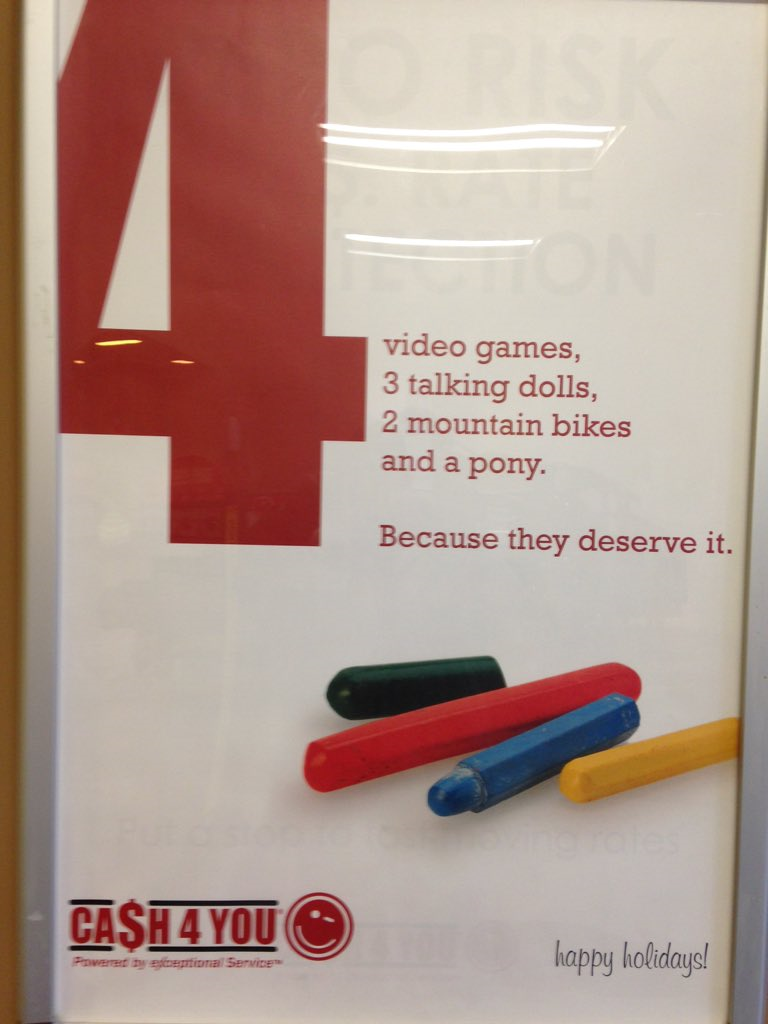
Recent example of advertising  used by the "Industry"
That should change. 

My Oxford English Dictionary  says “a crime is something disgraceful or very unfair.”

That ought to make these lending practices criminal.