Tuesday, February 16, 2021

Ford Government Turning Its Back on People Living with Disabilities


Tuesday's Toronto Star has a story by Brendan Kennedy on delays at the Social Benefits Tribunal. (SBT) https://www.thestar.com/news/gta/2021/02/12/delays-at-the-social-benefits-tribunal-have-tripled-leaving-odsp-claimants-in-extended-limbo.html

The SBT is an administrative tribunal that deals specifically with appeals regarding social assistance.  

The SBT hears appeals from people who have been turned down for the Ontario Disability Support Program (ODSP).  The law related to this program is called the Ontario Disability Support Program Act (1997). This program is designed to help people with disabilities who are in financial need pay for living expenses, like food and housing.

Why are the delays happening?

One reason is that the Doug Ford government has not been appointing new members to the SBT.  According to the story, there were 38 adjudicators when Ford won election in 2018.  There are only 26 now.

The real issue though is that the provincial government is trying to undermine the social assistance system.  They have no interest in supporting people living with disabilities.

For further evidence take a look at a recent piece in the Toronto Star written by Amira Elghawaby. https://www.thestar.com/opinion/contributors/2020/12/29/has-the-ford-government-cancelled-2021-for-ontarios-most-vulnerable.html

The story makes it clear that:

1. First-level decision by ministry staff to deny benefits is all about  protecting the public purse. 

2 But Ontario gives applicants right to evidence-based, independent review. 

3 The majority of appeals filed in 2020 have yet to get a scheduled date for a hearing.

4 The 80% success rate in appeals of ministry decisions is a critique of the original decision making not problems with the SBT.


The delays are bad enough but there is speculation that the SBT might be eliminated.

Read a recent letter from Laura Hunter and Michael Ollier, Co-Chairs of the Steering Committee on Social Assistance for Ontario Community Legal Clinic.  The letter is to the Attorney General of Ontario and the Minister of Children, Community & Social Services.  

“The right to an appeal process at the Tribunal is enshrined in legislation, and it is a vital one that needs to be preserved. Even in the best of application systems, it is only fair and reasonable to apply a check on the decision-making of Ministry staff.”  https://hamiltonjustice.ca/en/2020/12/10/alarmed-for-the-future-of-the-social-benefits-tribunal-and-appeals-process/

The Ontario government must preserve the important independent role of the Social Benefits Tribunal.  No one should be wrongly denied the benefits they need for their survival.


Friday, February 12, 2021

Getting Worse?

There is ongoing dialogue on social media focussing on Hamilton Ontario City Council and the performance of its members.  Today, long time City Hall observer Ryan McGreal notes "they're actually getting worse. More indifferent to suffering, more reactionary, more cynical, more shameless.”

I've  retired and moved away so it is hard for me to judge however, for what it is worth,  I offer this piece from my blog written nearly ten years ago, - May  2011.


Respect for Citizens Needed at Council Meeting 

May 25, 2011

Over the last ten years I’ve attended a couple of dozen meetings of Standing Committees of Hamilton City Council.

Usually I’ve been there to watch; occasionally I’ve been presenting. From time to time I‘ve gone home happy as the issue that had prompted my attendance had been resolved appropriately, from my perspective anyway.

But almost always I’ve headed out into the real world following these meetings out of sorts because of the lack of respect that Hamilton Council consistently shows for the public.

This lack of respect takes many forms.

First, meetings frequently start late, usually because of lack of quorum. Once I was there for a 9:30 meeting that was about to be postponed. Seconds short of 10:00 a Mountain Councillor raced into Chambers arriving just under the wire so the meeting could get started. (Not having a quorum within thirty minutes of the scheduled start means no meeting.) Let’s face it those who are there to present or listen have other responsibilities that need their time.

Second, Councillors, some more than others, feel the need to get up and leave the room a lot. To be fair it isn’t easy sitting for the hours that the job requires and some, OK most, of the dialogue is tedious but these pols knew what the job entailed when they put their names forward.

Third, and this is what really turns my crank, is the propensity some councillors have for talking with the media in the middle of meetings. Way back when we were toddlers we all learned that it was rude to talk when others are talking. And someone - staff, a member of the public or another Councillor - is always talking at a Committee meeting. In my experience most municipalities’ procedural by-laws cover such matters and committee chairs have the power to enforce.

 In this context I found Andrew Dreschel’s column in today’s Hamilton Spectator interesting.

Dreschel reports that Peggy Chapman from Mayor Bratina’s office wants to start “regulating interactions in the Council Chambers.” That would include, apparently, not allowing reporters to talk with councillors during proceedings and restricting councillors from talking privately with reporters during meetings. The columnist seems to think that the Mayor’s initiative may be more about “exercising control than good form.”

But if Dreschel and others took a look around they’d likely find that Hamilton is out of step with other cities who think that at the heart of good form is respect for citizens.

Wednesday, February 10, 2021

A Disability Inclusion Plan for Canada


Throne speeches are full of promises.

Amongst the many promises in the federal government’s September Throne speech was a commitment to come up with a Disability Inclusion Plan to address “long-standing challenges” facing Canadians with disabilities.

The Disability Inclusion Plan is a promise that should be kept.

The plan would be styled after the Guaranteed Income Supplement for Seniors. It would include a “robust” employment strategy for Canadians with disabilities.  A better process for determining eligibility would be developed.

The prime minister re-affirmed this promise in a media release on December 3rd, 2020.

It is an important initiative that seems to be flying below the radar.

The Hamilton Roundtable for Poverty Reduction put together a timely policy brief that

looks at the financial costs of disability.  It is a succinct 4 pager which you can read at https://hamiltonpoverty.ca/preview/wp-content/uploads/2021/01/HRPR-Policy-Brief-The-Financial-Cost-of-Disability.pdf

The data makes the case that we must acknowledge “the severity of structural poverty for persons with disabilities.”

Any new benefit must ensure that persons with disabilities can be lifted out of poverty “to a truly dignified standard of living.”

Some Insights from the Roundtable Report

There are significant costs associated with life-long disability.

All medical needs are not covered or accessible through existing programs.

There should be full support for social inclusion.  Adequate resources to permit full involvement in the community must be provided.

Everyone with disabilities isn’t able to work full time. That means incomes must be supplemented to account for lower life time learnings. 

Learn More: Plan Institute has put together on Building Momentum for the Canadian Disability Benefit which you can find at https://planinstitute.ca/learning-series-canadian-disability-benefit/


Monday, February 08, 2021

Just a Thought- How about a Caretaker for Ward 2?


On Tuesday,  Norfolk Council will consider a 41-page staff report on how to fill the Ward 2 Council vacancy.   https://www.norfolkcounty.ca/wp-content/uploads/2021/02/CIC-Agenda-Feb-9.pdf

We live in a democracy so a by-election is clearly the way to go.

Some will take issue with the financial cost of such a by-election.  Not me.  The expenses are pegged at a reasonable $22,000-$33,000.

However,  as with everything else these days, the pandemic puts up significant barriers to a successful by-election. 


Staff identify these obstacles and list special procedures that could address legitimate  health and safety concerns.  Some examples: 

*The nomination process set out in provincial legislation can’t be amended.  That means that at least 25 people must sign a candidate’s nomination papers.  Since electronic signatures are not allowed a separate form for each signature is needed to reduce touch points of the mandatory forms. 

*Door to door canvassing is problematic.  Staff recommend that candidates undergo a daily health self assessment; door campaigning should take place “through the door” whenever possible and hand sanitizer should be used by all involved in campaigning.

These are all good ideas but impractical and not easily enforceable. 

Other Concerns with a By-Election

There are issues with voting methods as well ;  “complexity” concerns with internet voting, for example.  And internet access is problematic for many in Ward Two.   

Staff prefer a mail-in ballot, although the accuracy of the voter’s list is a big problem which can’t be resolved until 2024.  

One concern not mentioned is that the successful candidate won’t be sworn in and able to begin serving Ward 2 and Norfolk constituents until June 8th. As we know it takes quite a while to learn the ropes in any new job.   Municipal government presents a big learning curve for new members.  By the time the new councillor is up to speed the October 2022 municipal elections will be here.

Given all the above the appointment process might be a better approach. Here is a thought:

A Caretaker

In 2006, I was selected over 20 other applicants through a transparent community process as Ward 5 Councillor for Burlington/Halton.  That process involved a public meeting and an in-camera interview (allowed under the Municipal Act) with Council and senior staff.

What did I offer?  For six years I’d served most of that ward as Councillor before deciding to return to my old field of work.  Voters had not tossed me out and that, I’m sure, was a consideration.  

I had been off council for more than eight years but still had an understanding of how local government generally and local governments specifically worked.  What was most important though was,  in combination with my experience,  I made a commitment that I would not run in the upcoming municipal election.  As Norfolk staff correctly note in their report there is a huge advantage for incumbents in municipal elections.  It can be argued that those who have that advantage by being elected by voters deserve it.  But one who has not faced the electors certainly doesn’t.

I spent nine productive months as a caretaker councillor. I worked with constituents, brought forward some new initiatives that had been put to one side, plugged away on Official Plan updates that I had background on from my earlier term on council and other matters.  I was also quite involved in promoting civic participation through organizing and chairing an all candidates meeting and making myself available to discuss issues with those candidates.

Norfolk County

An appointment process with interviews in public and applicants’  intentions for the next election being factored in to the decision could be the way to go for Norfolk. 

As far as I’m aware, candidates in an appointment process can’t be required to commit to not contesting the next election.  In fact, I recall some who made such a promise then broke it.

My view is that Council can ask for the commitment and if it is broken then the voters can decide in 2022.  

That would be the democratic thing to do. 


Tuesday, January 26, 2021

One Minute Review


Finding  Murph

Rick Westhead

Harper Collins, 2020

First-rate story about an NHL star victimized by the league’s failure to recognize the long term impact of concussions.

Focusses on Joe Murphy who won an NCAA championship with Michigan State and a Stanley Cup with Edmonton. The 1986 first draft choice played 779 regular games over 15 NHL seasons (233 goals & 528 points) adding 77 points in 120 playoff games.

Sure Joe was a different kind of guy affectionately described by teammates as “odd,” and "an airhead” but when he took a hit to the head on Jan 9, 1991 and things changed.

Westhead strengthens his thesis through access to many documents and e-mails previously under seal with US courts in connection with a concussion lawsuit.

The e-mails reveal the league’s mindset.  Medical people who warned of long term damage were “dumbass doctors” just putting out “imbecilic rants” with “no idea what they are talking about” because, of course, they had never played.

They were “tree huggin…leftist doctors… that soon won’t let us climb stairs for fear of concussion,” wrote the NHL’s director of officiating.

We “view ourselves as a family” said NHL Commissioner Bettman, who called any evidence of concussion brain damage anecdotal.   What family would reject care of a loved one by denying the science?  “No conclusive link,” Bettman would say as recently as 2019.

Meanwhile, Joe Murphy is homeless in Kenora (when the book ends) and apparently still today in Saskatchewan.

Like Ken Dryden’s Game Change Westhead’s book is a clarion call for the sports world to take concussions more seriously.


Monday, January 11, 2021

Looking for Authentic Voices


Some years back when Jean Chretien was the Prime Minister of Canada a man attended the leadership convention of a Canadian political party.

It is a little-known fact that of countries with a parliamentary system of government, Canada is the only one that has taken on a form of the American national party convention as a way to choose its leaders.  The first such convention was held in Canada in 1919 in Ottawa.
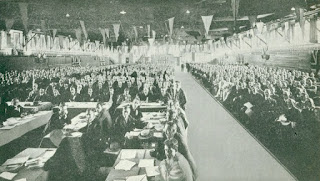
1919 Liberal Convention - Landsdowne Park, Ottawa from Library and Archives Canada
Liberal Convention 1919 - Library Archives Canada

Put simply a leadership convention is one where party members chosen as delegates convene and choose a leader by voting.     

 This man, William, was not an important player at the convention – just an ordinary delegate, one of about 1,500.  

Policy debates took place and the leadership candidates gave speeches and hosted hospitality suites. Then came the voting for a new leader.

The candidate who William supported was ahead after the first ballot. According to the rules, the candidate who finished last on the first ballot was eliminated.  His elimination meant that his supporters could now vote for one of the other candidates on the second ballot.  

During the time before the second ballot voting began there was much excitement.  Music played, delegates marched and danced around the hall chanting and calling out for others to support their favoured candidate.  The major television networks captured the contrived hoopla of modern-day democracy. 

Together with other delegates William sashayed around the room carrying the sign of the candidate who he had supported on the first ballot.  As he made his way somewhat self-consciously around the perimeter of the hall, a young volunteer organizer for the leading candidate offered him a sign belonging to the eliminated candidate.  William recognized the young woman as she was an active member of his local riding association. In fact, at the last riding association meeting she had successfully presented a motion that advocated for the establishment of a proportional representation system of voting.

William took the sign and continued to march around the hall displaying the signs of two candidates. Those watching might assume that he was now shifting his vote from the eliminated candidate to the leading one.  To people watching this all seemed very authentic.  In truth, William did not particularly like the eliminated candidate and had not voted for him.  

However, in the hall many people applauded William.  To them, this delegate seemed to be holding up well even though he must surely be disappointed that his candidate had been eliminated. For them this man was making a wise choice for his second ballot vote.  

William considered himself to be a truthful person.  Most people who knew William would confirm this. And it was certainly not a lie when he took up the second sign. However, he felt some slight amount of guilt for his actions.  He wasn’t destroying opponent’s election signs or selling bogus memberships or anything malicious or illegal  but his actions were not authentic ones.

For centuries philosophers have explored the concept of genuine authenticity in public life.  It is considered an essential attribute of modern democracies.   But as time wears on the concept of authenticity is eroding faster than the Athabasca Glacier. 

Several years before this convention William had been a reluctant candidate for public office. He was persuaded to run at the last moment when the previously nominated candidate had been offered and accepted a job in the public service as a Communications Specialist.

While William knew the issues, he wasn’t a good public speaker, didn’t know how to work a room and thought that knocking on people’s doors was an invasion of their privacy.   William believed, not surprisingly, that these were serious shortcomings for a candidate for public office.  Somewhat like a vegan suddenly being put in charge of grilling at the service club’s annual ribfest fundraiser.

“Don’t worry,” he was told.  “Just be you.  Be true to yourself. That’s all you need to do.”

William passed this advice on to his long-suffering wife, Ruth.  Ruth wasn’t terribly interested in politics.  She wasn’t sure if “being yourself” was the best advice in her husband’s case but she always encouraged him in his endeavours.

“Yes, go ahead run. Be yourself, but be restrained in doing it,” she advised.

The riding association had apparently done some preliminary polling and William had scored fairly well for someone who was not well known.  William was also encouraged by this polling but wasn’t sure why.

While he hadn’t been elected, hadn’t really come close to winning in fact, William had knocked on many doors and had presented his party’s platform ideas to the public as he was expected to do.  Much to the consternation of William’s campaign manager, who didn’t want the candidate to spend an excessive amount of time at each house, William also listened to those people who answered their doors and made an effort to appreciate their concerns.  William found it noteworthy that their concerns were not in line with what his party and the other parties were talking about.  The parties were talking about national unity, Arctic sovereignty and trade agreements. But the people William talked to were more interested in jobs, plant closings and whether they’d be able to swim at the lake this year.  

Something was happening in town. Not a noticeable overnight change but a gradual move in thinking that politics and politicians didn’t have the answers to today’s problems.

People were disillusioned with public institutions.  They were looking inward and opting out of being involved with the broader community, although they were doing this reluctantly, William thought. 

At the time, William read reports from experts who had identified this trend.  These experts believed that many people felt they had no voice in their government.  So, they were falling back on themselves and beginning to explore personal “authenticity” that was unconnected to the wider community.

To William this was just a long-winded way to say people were becoming disengaged with government and their communities.

Of course, William knew nothing about social media when he had been a candidate and at this particular convention as these events pre-dated the advent of this new technology.  Later, as social media matured, experts would assert that social media offered the potential of genuine authenticity.

For her part, the young organizer who had passed the sign to William continued in a career where she advocated for progressive policies. 

It was her belief that as social media evolved it would offer regular people the opportunity to speak their minds unencumbered by commercial media constraints.  After all, what could be more authentic than an individual, independent blogger or Facebook user speaking out on whatever s/he thought needed to be said?

The organizer was hard working, idealistic and committed.  Working in the non-profit sector she learned how to use social media to promote causes important to her.  She returned to the political world around the same time that politicians discovered how to manipulate social media for their own selfish purposes.

Like the young organizer and the man at the convention, the politicians and their advisors thought strategically.  But their thoughts were on a larger scale, a much larger scale. 

They recognized that blogs, Twitter and Facebook provided an opportunity to present the “real and authentic” side of politicians.

In order to learn from these political experts, the young organizer, Jennifer Taylor, was sent for training at the School for Democratic Political Organizing.

Jennifer took a train to the city.  She was most eager to learn from the trainer, who was himself an experienced organizer, as well as others who would be attending.

The trainer was well prepared and professional looking.  He was dressed in trousers, a button-down shirt (good for accommodating a lavalier), a tie, and jacket. He followed the trainer’s technique book by dressing one level up from the trainees.

The trainer used pithy dialogue and appropriate and up to date presentation materials. 

His case for authenticity went along these lines.

The politician needs to be seen as a genuine person.  The voters need to understand that s/he is one of the people – someone with whom you would enjoy having a beer; someone you could trust to babysit your kids.

Through the use of appropriate social media your candidate can reach voters with a message that you will be able to deliver in a clear un-edited way.  And, by doing this you will bypass the fallacious fourth estate, he said.

The trainer shared a list of ten tactics that must be incorporated into every social media strategy.  Number 6, the Lyndon Johnson “make-em-deny-it maxim” stood out for the organizer.

It has long been reported that, during a Texas election, Lyndon Johnson, the 36th President of the United States, ordered aides to put out a rumour that his opponent, a former pig farmer, was amorous with the farm animals.

When Johnson issued this order an aide responded, “We can’t prove that.”

I know, Johnson apparently replied.  “I just want him to deny it.”

So here is how “make-em-deny-it” works today in the world of social media.

A candidate who you oppose makes a statement. Put out your own response.  It doesn’t need to be totally accurate.

Now this means there will be at least a couple of points of view out there. You need to do this as soon as you can. If you are skilled in putting that piece out it will go viral before it can be fact checked. 

Members of the public, reporters, journalists, and bloggers won’t have the time or ability to verify claims. By the time they do, if they do, your story will have become embedded in the public’s mind.

“But this is wrong,” the young organizer interjected.  

“How is that,” responded the trainer?  It seemed he was ready for an argument.

“This challenging of real facts with half truths, half baked conspiracy theories and misinformation just makes the public more cynical.”  

“Look Ms. Taylor.  Are you in this to win debating points at the Socrates School of Ethics or are you in this to win?”

The trainer explained that studies have been done that tell us that if people go after the information that you’ve put out by directly trying to refute it; they may actually have the effect of spreading your information even more.  

“In other words, it works.”

So, the lesson in authenticity that the organizer would take back to her constituency was in fact about an authenticity that should be carried out as a strategy. It was not really a genuine authenticity.  Genuine authenticity was a goal that Jennifer thought all individuals should pursue. 

The organizer left the training somewhat disillusioned but returned home confident that in her constituency work she and her other campaign volunteers could manage their social media in a way that would be authentic and not a phony strategy like the one advocated by the trainer.

Not surprisingly, she bumped into that man who she had handed the sign to at that long-ago convention.  He was involved with Jennifer and others on the election planning committee for their local candidate. William had been doing some reading on campaign strategies used by the President of the United States.

“Look at that guy down in the White House?  He lies all the time.  But a lot of people will tell ya he seems authentic. I don’t get it.  Do you?

The young organizer took a deep breath.  “Hmm.  Well, those people you are referring to believe he says what he means.  He is not like all those regular politicians. That’s what they think, anyway.”

“But what he says isn’t true most of the time.”

“He doesn’t worry about that.  He lies authentically and somehow it works.”

The two shook their heads, wondered what was becoming of the world and how all of this would impact their local campaign.

Then two days before the election was called the independent, non-partisan agency of Parliament responsible for overseeing elections made the following announcement.

“Due to interference in our social media by foreign powers we have made the difficult but necessary decision to make it illegal to use social media during the upcoming election. Any candidates, political parties and third parties engaged in election advertising will face heavy fines and possible jail time for infractions.  Only through these actions will we be able to ensure the authenticity of our elections.”

At the campaign team meeting the day after the announcement William and Jennifer and the rest of the team were worried.  They had spent months organizing their campaign and it was heavily dependent on the use of social media. 

“What will we do now,” Jennifer asked the assembled volunteers?

There was silence.  The new rules on social media had come as a big surprise to everyone.

Then from back of the office came shuffling noises. It sounded like someone was struggling with an awkward load as they tried to enter through the back door.  Soon, William’s diligent wife Ruth entered the room.

“I’ve been clearing out junk, old papers and the like out of William’s so-called home office and came across these boxes of campaign strategy books from the 1991 election.  Are they of any use?”

The volunteers all turned to look at Jennifer Taylor.  Jennifer smiled serenely.

“Well Ruth, the answer is yes.”

Postscript

And so Jennifer’s team ran what they believed to be an authentic campaign. They worked hard to engage with voters in honest face to face dialogue. Their advertising and promotional material emphasized the positive aspects of their platform and did not mis-represent their opponent’s positions.  While other campaigns found a way around the restrictions on social media, Jennifer avoided its use. They failed to win the riding although they did significantly better than in the past.

People noticed what this campaign was doing and there was praise for it.

The only remaining newspaper in town even editorialized about Jennifer’s team’s campaign calling it a return to what politics should be all about – an authentic politics.  

-----

Looking for Authentic Voices was published last year in Literature for the People (Editor Raymond Fenech).


Thursday, December 31, 2020

A Good Walk Perfected


Sometimes I wonder whether what I’ve written is relevant.  Perhaps at a point in time a piece was newsworthy or interesting.  However, time and current events often catch up and leave your piece as something to be filed under “P” for passed its best before date.

However, this story, basically a report on a presentation on birds and birding, seems more relevant today that when I put fingers to keyboard back in May of 2014. 

----

It has been said that golf is a good walk spoiled.

But birding is “a good walk perfected.”  That was the message Jeff Gordon brought recently  to a large group of outdoor enthusiasts at Bird Studies Canada’s (BSC) National Office in Port Rowan just about 400 metres from my residence.

Yes, we have a National Office in Port Rowan. And Gordon, a celebrity in the birding world was a most able and appropriate speaker as spring migration is ramping up here on Ontario’s South Coast.

Gordon heads up the American Birding Association (ABA), a non-profit organization that provides leadership to North America birders and also contributes to bird and bird habitat conservation through its programs.

He was in town to participate as the Celebrity Birder in the annual Baillie Birdathon as well as to speak at this special event billed as a Celebration of Birding.

Gordon is passionate about birding and birds.  He worries, though, that birders need to open up to others who may be interested in nature and the outdoors but are intimidated by the vast knowledge many experienced birders present.  Rather birders need to be “evangelists” about their hobby and help “break down barriers” for newcomers.

Gordon’s presentation included plenty of action shots of birders from around North America including Alvaro Jaramillo. (Jaramillo coined the “good walk perfected” line.)  The ABA head takes these types of pictures because birders are good at taking photos of warblers and eagles and the like but not so good at taking pictures of people enjoying birds.  More images that capture the “grandeur of birding” are needed.

Earlier in the day, local ornithologist Tim Lucas found a rare Kirtland’s Warbler near the entrance to the new Long Point Provincial Park.  This is considered North America’s rarest warbler and is normally found only in a small area in the north central part of Michigan’s Lower Peninsula during breeding season.

Gordon and a dozen or so others were there.  He captured the excitement on his smart phone and shared the footage in the evening presentation thereby reinforcing his key message.

I think Gordon made his point well that night.  The next day another relatively rare bird was located in the area.  Check out this picture from Jody Allair's twitter account and you should be able to share in the enthusiasm with those seeing a Bell’s Vireo for the first time.


-----

This story was originally published by Forever Young, a Metroland paper.


Update:

**In 2020 Bird Studies Canada changed in name to Birds Canada.  That change is recognition that their work extends beyond the study of birds and encompasses “public engagement, habitat stewardship, education and training, involvement in guiding conservation decisions, and more.”

**If you’re not doing anything on New Year’s Eve, join the American Bird Association (ABA) as they announce the new Bird of the Year at midnight St Pierre et Miquelon time (10 pm EST)